Community mental health’s unsung heroes: Ashley Gibson, recovery coach
Gibson’s journey from inmate to recovering addict to recovery coach gives her a unique perspective.
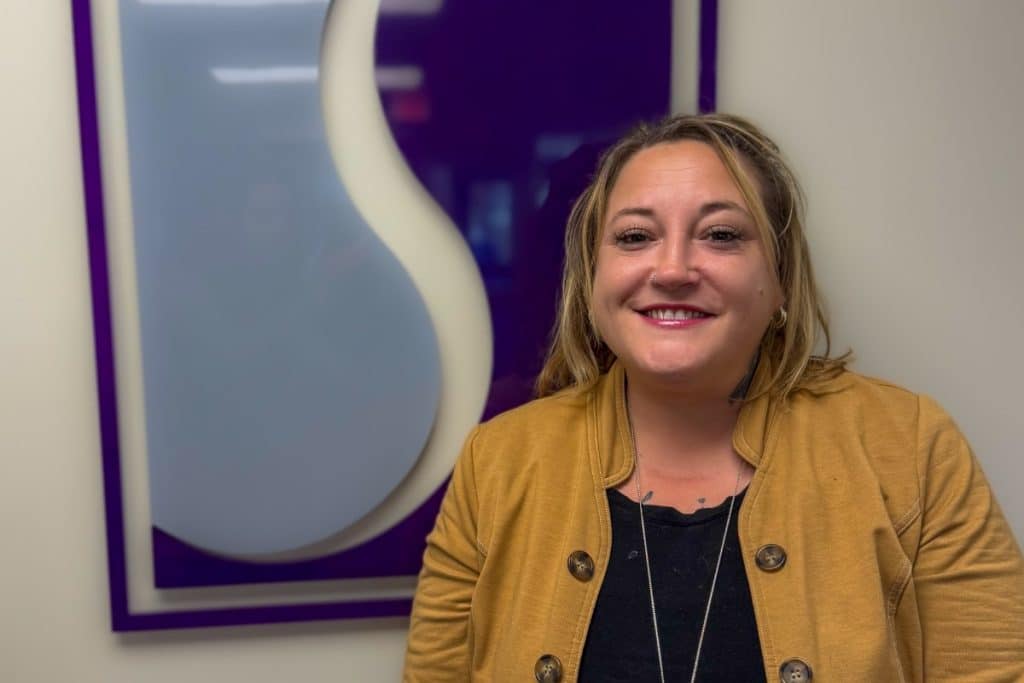
At one point in her life, Ashley Gibson couldn’t wait to get out of jail. She now hopes she never has to leave the Calhoun County Jail, where she works as a recovery coach with the Summit Pointe Jail Services Program, a team of four: Two case managers, a clinician, and Gibson. Summit Pointe is Calhoun County’s community mental health agency.
Gibson’s journey from inmate to recovering addict to recovery coach gives her a unique perspective that the incarcerated men and women she works with relate to. They are willing to listen to what she has to say because she has been where they are now.
“They are surprised and say ‘You were in here before?’ because there is this idea of an addict being this dirty, homeless person who has no teeth. There are so many people who might be struggling with substance use or mental health, and you’d never know it by looking at them,” Gibson says. “My family didn’t know until things got very bad. The whole world has this idea of what an addict looks like on the outside.”
Gibson says a really good recovery coach doesn’t throw up their hands and walk away. Instead they advocate for inmates “who know how much we had to work to get where we are.”
“The things I’ve done and been through and made it through and continue to make it through, that helps people understand that what I talk with them about is not just something I read about,” she says. “I do share my story where it’s appropriate. There are girls there that I’ve been in jail with. They ask questions.”
Incarcerated inmates with substance use disorders who have not yet been sentenced meet with Gibson to focus on the plans they formulate in Smart Recovery, an evidence-informed approach to overcoming addictive behaviors and leading a balanced life. Gibson says having a plan is key to preventing a relapse.
A new start
Normally, people with criminal records aren’t allowed back into the jail, but exceptions were made for Gibson. She graduated from Calhoun County’s Drug Treatment Court, which referred her to Summit Pointe for outpatient counseling and group therapy. The positive experience prompted her to seek a job at Summit Pointe eight years ago.
“I knew I needed to do something that had purpose and meaning. I went up there with my resume and ended up getting hired a couple months later,” she says.
The jail services team creates a release plan for each inmate. Once individuals are released from jail, Gibson and the team keep in touch with them to reduce risk of recidivism.
“We follow people to make sure they get what they need,” Gibson says. “If someone’s barrier is housing, we connect them with housing. We give out backpacks filled with toiletries, gloves, hats, and clothes. If they need to go to treatment, we do that, too. If they just need to be connected to services or medications or the VA (Battle Creek Veterans Administration Medical Center), we do all of that.”
Housing is the biggest need, followed by transportation to court appearances or a job. What they were charged with can limit the jobs they are able to get. Gibson worried about the type of jobs that would be available to her after she was released from jail.
“It could have been a lot harder for me because I do have two felonies,” she says.
Recovery is forever
Alcohol and opioids became Gibson’s go-to coping methods after delivering her second child through a difficult caesarean birth.
“I was kept on painkillers for nearly two years. Within a couple of weeks, the addiction had taken off,” Gibson says. “It took the pain away. It was like a mom’s miracle drug. I could take it and get everything done and go to work.”
But not for long. Within a year, she lost her job because the addiction had consumed her.
“The more things you lose in addiction, the less of a reason you have to quit,” Gibson says. “Addiction takes over your life to the point that it’s what you live for every day. You could care less about food, shelter, safety, and the people you love who love you.”
For Gibson, rock bottom was losing custody of her children and racking up felony charges. She says she never would have made it without the support of her husband, her family, and her experience as a client of Summit Pointe.
“I had a counselor who really understood addiction and also the grieving I was going through as a mother not having my kids,” she says. “It was helpful to be around people doing the same thing.”
Gibson stays in touch with her sponsor, attends meetings, and works on her own plan to stave off a relapse. Working in the jail reminds her of her own milestones as she witnesses other peoples’ success. After losing her mother to bone cancer in 2020, she did not relapse.
Now 41, her daughters are back in her life, she has a steady job that she loves, and she follows her plan to maintain what she worked so hard to get back.
“I thought it was going to be hard to walk back into that jail, but that didn’t happen,” Gibson says. “There are hard things to see, but every day something good will happen with somebody … I think this is where I’m supposed to be.”
Photo of Ashley Gibson courtesy Summit Pointe.
Other photos by John Grap.
The MI Mental Health series highlights the opportunities that Michigan’s children, teens and adults of all ages have to find the mental health help they need, when and where they need it. It is made possible with funding from the Community Mental Health Association of Michigan, Center for Health and Research Transformation, Genesee Health System, Mental Health Foundation of West Michigan, North Country CMH, Northern Lakes CMH Authority, OnPoint, Sanilac County CMH, St. Clair County CMH, Summit Pointe, and Washtenaw County CMH.
Related Articles

Policies, programs, and research shaping maternal mental health care
How the Center for Health and Research Transformation is working to improve mental health for pregnant and parenting individuals.
Statewide effort tackles postpartum depression and perinatal mood disorders
One of every five* new mothers experiences perinatal mood disorders, but only a small number receive the help they need. The Michigan Health and Hospital Association is working to change that.
Local networks, real results: Success stories from Michigan’s CMHs
Michigan’s community mental health agencies serve as lifelines and innovators.