Safe speed: Why towns in Ohio are slimming down their main roads
The “road diet” is increasingly being considered to slow speed while at the same time keep traffic flowing.
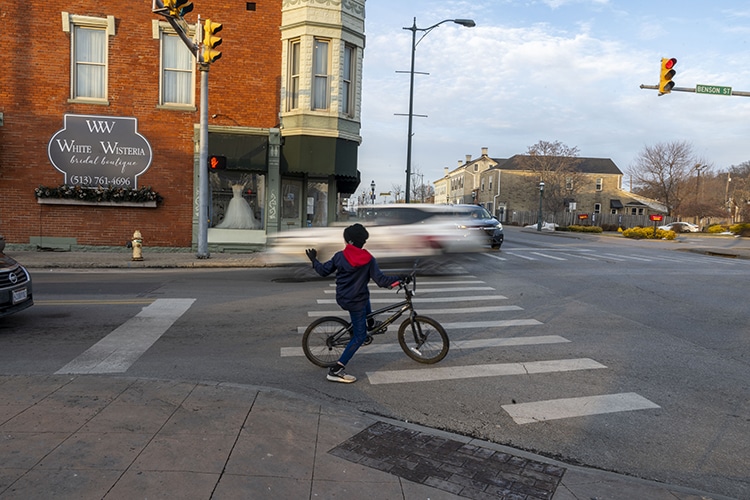
Cincinnati’s first-ring suburbs face challenges including changing demographics, economics, and security. The ways the 49 cities, villages, and townships in Hamilton County meet these challenges is the focus of this series, First Suburbs—Beyond Borders. The series explores the diversity and innovation in these longstanding communities, highlighting issues that demand collective thought and action.
Speed kills. It also injures, maims, damages and destroys.
Americans in the 21st century enjoy the luxury of easy, quick, personal travel in comfortable vehicles that can go very fast. The tradeoff is a civilized version of mayhem.
Last year, 1,125 people met their end on the roads in Ohio. In Kentucky, 707 people were killed in their vehicles (2024), and 926 met that fate in Indiana. In the U.S., nearly 41,000 people died.
Although traffic deaths have fallen in recent years, the violence has safety and transportation experts, as well as government leaders, looking for ways to slow traffic. “Make no mistake — the number of people killed on Ohio’s roads remains far too high,” says Gov. Mike DeWine. In the towns and cities around Hamilton County, many of which have major transportation corridors running through them, the “road diet” is a tactic that is increasingly being considered to slow speed while at the same time keep traffic flowing.
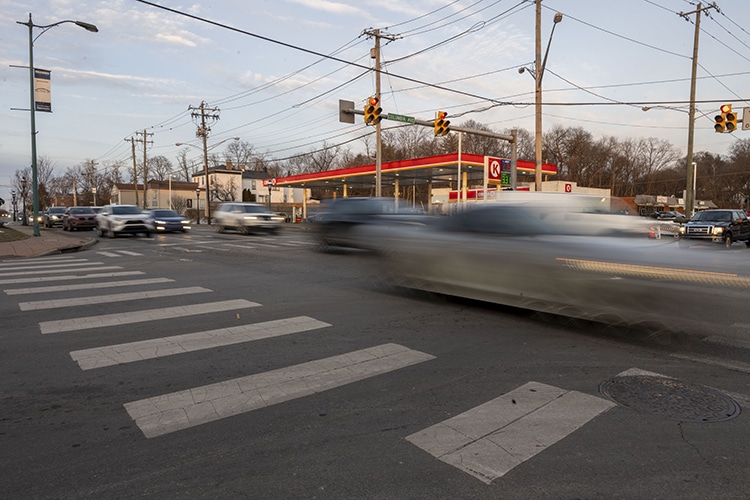
The latest example is in the city of Reading, where state and city officials are planning to restructure a 1.9 mile portion of U.S. 42, Reading Road, that runs through that town’s business district. The posted speed limit is 25 mph through there, but motorists routinely drive 10 mph faster than that, state transportation officials say. Speed, plus the fact that Reading Road is four narrow lanes, two in each direction, has contributed to 252 crashes along that stretch in the last three years. “That’s a lot,” says Jeremy Thompson, a safety engineer with the Ohio Department of Transportation.
The state selected that section of Reading Road as one of seven around Ohio where it says a road diet would make travel safer. On Reading Road, it plans to turn four nine-foot lanes into two 12-foot-wide lanes with a 13-foot turn lane in the center. Eight-feet parking lanes would be configured in each direction, and curb extensions would ensure that motorists could not travel in the parking lanes. Five raised crosswalks and medians would help to slow traffic and protect pedestrians, as would two flashing crosswalk beacons that pedestrians could activate.
“The speed limit is 25,” says Anthony Pankala, an environmental engineer with ODOT. “We’re designing the road for what the speed limit is.”
Road diets make the roads safer, the department says. In eight other sites around the state that went on a road diet, crashes, fatalities and injuries were reduced. Total crashes fell by 23% in the year following the changes, while bicycle and pedestrian crashes fell by 55% overall at the eight sites, ODOT says.
The single lanes, curb extensions and raised crosswalks will slow traffic more consistently than police enforcement can, ODOT engineers say. And as many towns across the county struggle to fund growing costs for police, using police resources to slow speed to monitor traffic takes police personnel away from other duties.
Using police to write speeding tickets is not the best option, says Reading Mayor Robert “Bo” Bemmes. “We can’t cite our way out of these problems,” he says. The road diet, he says will work to calm traffic “24 hours a day, seven days a week. No tickets, no cops required.”
Reading Road is what U.S. 42 is called in the city of Reading and Hamilton County. U.S. 42 is a 100-year-old highway that stretches 350 miles from Louisville to Cleveland. Routes like that are how people traveled from state to state before the interstate highway system was built.
Today, U.S. 42 carries about 15,000 vehicles a day through Reading. Many of them are semi-tractor trailers, as U.S. 42 is a key corridor for local and regional truck traffic. The standard lane widths for truck traffic is typically 12 feet to accommodate today’s larger haulers. U.S. 42 lanes are only nine feet wide through Reading, which transportation experts say is a big reason for sideswipe crashes, which account for an outsized percentage of the wrecks in the corridor.
Even when wrecks are not fatal, they can still cause injuries, tie up police and emergency personnel, contribute to rising insurance rates and damage property. Despite the apparent safety advantages, road diets are often met with skepticism by the traveling public. Reading is no exception.
At a public meeting at the end of January, most speakers said they opposed the changes. Traffic will back up with only one lane to travel in, several said. Residential side streets may see more traffic, others said. Some business owners were concerned about the ease of making turns into and out of their shops.
Others spoke in favor. One man who bicycles to work in Sharonville said he travels miles out of his way to avoid dangerous spots in Reading. Another praised the road diet that was done on Hamilton Avenue in the Cincinnati neighborhood of College Hill. “I feel safer driving to work in the morning,” she said.
Other first-ring suburbs in the county have seen their main thoroughfares slimmed down in recent years, with the result being calmer, slower traffic. The plan can also have the benefit of transitioning busy thoroughfares into something resembling community assets rather than high-speed pass throughs, supporting local businesses and promoting a small-town atmosphere
A road diet was completed in 2020 on a two-mile portion of Springfield Pike (Ohio 4) in Wyoming. The project has improved traffic flow and reduced collisions. Since the project’s completion, the city has seen a 27% decrease in crashes involving injuries, and a 21% decrease in crashes involving property damage, city officials say. The neighboring village of Woodlawn is now considering similar options to slow traffic on its portion of The Pike.
READ MORE: Taming The Pike: How one town wants to turn a busy roadway into a village square
In 2024, a road diet was completed on Harrison Avenue in the city of Cheviot’s business district. That included installation of curb bump-outs, flashing beacons, a raised intersection, raised crosswalks, and new pavement markings and signs.
Around the state, more than 100 roadways met the transportation agency’s criteria for converting them from four lanes to three, Thompson says. ODOT officials chose seven, including Reading Road. The state, not the city of Reading, will pick up the estimated $3.7 million cost.
Reading city officials have not signed off on the project yet, and Bemmes said the city is still accepting feedback from residents and business owners.
First Suburbs—Beyond Borders series is made possible with support from a coalition of stakeholders including the Murray & Agnes Seasongood Good Government Foundation: The Seasongood Foundation is devoted to the cause of good local government; Hamilton County Planning Partnership; plus First Suburbs Consortium of Southwest Ohio, an association of elected and appointed officials representing older suburban communities in Hamilton County, Ohio.
Author

Related Articles

Kansas City neighborhood is transforming neglected housing and keeping control local
Since 2018, the Lykins Neighborhood Association has been taking on ambitious projects including using a state law to take control of abandoned homes.
Trans Empowerment Network is building infrastructure where formal systems often fall short
Trans mutual aid is not a substitute for public services, nor is it charity. It is a practice rooted in shared responsibility, relationships and trust.

What does a neighborhood look like when it controls its future?
People who feel their voice matters are healthier and empowered. As divisions nationally appear to become deeper, this series, part of the larger Health Justice in Action project, examines efforts to make voices heard and improve community connections.