Pilot in two Michigan cities will guide strategies for lead pipe replacement across the nation
New project help municipalities secure funding for lead service line replacement.
In 2014, the Flint Water Crisis brought lead poisoning to the attention of Michigan’s public health agencies, municipalities, and residents. Across the state, lead exposure from aging housing stock, contaminated soil, and lead water service lines still threatens public health. Lead poisoning impairs children’s physical growth and healthy brain development. In adults, it causes hypertension, joint and muscle pain, mood disorders, headaches, and cognitive issues. The Centers for Disease Control and Prevention states that no safe blood lead level has been identified for young children.
In 2018, the State of Michigan instituted lead service line replacement mandates. In 2024, the Biden-Harris Administration issued the Lead and Copper Rule Improvements, mandating that water utilities across the country replace lead service lines within 10 years. In fact, the federal mandates were based on Michigan’s. Federal funding for making these replacements was also earmarked in 2024. Now that the funding is no longer available, municipalities like Bay City lack the means to fulfill the mandates.
The Michigan Municipal League Foundation MI Water Navigator program has helped Bay City and more than 173 other Michigan local governments secure funding for water infrastructure projects.
When Bay City embarked on the lead service line replacement, the cost to complete the project was estimated at $30 million.
“I can tell you that the price has not gone down,” says Marty Jurish, Bay City water distribution/meter manager.
Located on the Saginaw River upriver from Lake Huron’s Saginaw Bay, Bay City is home to roughly 32,000 residents. The city has replaced 13,066 lead service lines since 2019, leaving 3,260 still needing replacement.
“Compared to other communities in the state of Michigan, we are much further along than most,” Jurish says. “At this current pace, if we can keep it up –– especially if the funding is there –– we would probably have them complete in five to seven years.”
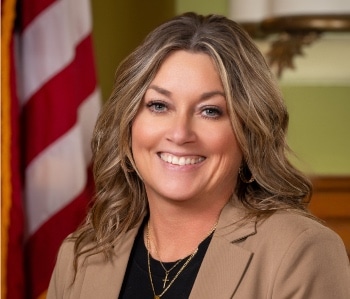
“Of course, we’re concerned about children and families in the area,” adds Dana Muscott, Bay City city manager. “I can honestly say, having worked at the water plant myself, that we do provide a very good quality tap water.”
Because Bay City began work on lead pipe replacement shortly after the Michigan mandate, its project is ahead of the national curve.
“When this all came about right after COVID, we got some ARPA [American Rescue Plan Act] money that comes to an end at the end of this year. To overlap that, we just got approved for a $5 million DWSRF [Drinking Water State Revolving Fund] loan through EGLE [Department of Environment, Great Lakes, and Energy] with $2.5 million of that forgiven,” says Jurish. “That is going to go a long way to keeping us on our road to full replacements.”
Bay City has replaced 13,066 lead service lines since 2019, leaving 3,260 still needing replacement.
Another reason Bay City has made such great progress was its participation in the Michigan Municipal League Foundation MI Water Navigator program, which helped Michigan’s local governments secure funding for water infrastructure projects.
“We’ve worked with the Michigan Municipal League for so many years on other programs,” Jurish says. “They made things easy, made us aware of some of the stuff we didn’t even think of.”

Bay City and Dearborn chosen for pilot
When the Michigan Municipal League Foundation began developing a new project to assist Michigan municipalities in securing funding for lead service line replacement, Bay City and Dearborn were chosen for its pilot.
“We worked with Bay City and Dearborn to figure out what is working well, what kind of innovative strategies for financing and cutting costs are working, what’s not working, and what the specific funding gaps are as they try to meet the 10-year federal timeline for lead service line replacement,” says Grace Carey, Ph.D., program officer for The Foundation. “We ended up building a pilot, a set of eight specific financing strategies.”
The strategies suggest ways to increase efficiencies and reduce costs without reducing quality.
“We’re never going to recommend that a community saves money by putting in PVC pipe that’s just going to lead to new problems,” Carey says. “We’re going to help them find ways to save money by buying the copper pipe that’s the safest option for their community.”
The strategies also recommend innovative funding mechanisms, e.g., direct community investment funds, an emerging charitable revolving fund that can incorporate crowdfunding.
“These are not a revenue source that communities typically think of for an infrastructure or capital improvement project,” Carey says.

The Foundation’s goal is for the two-year pilot to directly benefit Bay City and Dearborn while validating the eight strategies.
“As with any pilot that we do at The Foundation or at The League, we are providing a direct benefit to the participating pilot communities,” Carey says. “In this case, we provided both Bay City and Dearborn with a $20,000 lead service line seed funding grant meant to help them start building a new capital stack or plug into their current capital stack. We know that that’s not very much money for lead service line replacement, but we left it completely no strings attached.”
The pilot is testing eight innovative strategies for financing, cutting costs, and meeting the 10-year federal timeline for lead service line replacement.
Before sharing the strategies with Bay City and Dearborn, The Foundation tailored them to fit the specific needs of each community.
“On the flip side, the high level version of these strategies will be helpful for other communities, across Michigan and even across the U.S.,” Carey says.
Meanwhile, Jurish and his staff continue their work to ensure Bay City residents have safe drinking water.
“It is my opinion that any lead is too much lead,” Jurish says. “Our water treatment plant does a great job treating the water. We haven’t failed a lead test in probably 10 years or so before this mandate.”
Federal funding for making these replacements was also earmarked in 2024. Now that the funding is no longer available, municipalities like Bay City lack the means to fulfill the mandates.
When the pilot wraps up and The Foundation disseminates the eight strategies more widely, communities within Michigan and across the nation will have guidance on how to find more funding to replace all lead water service lines. Muscott also hopes that the federal and state governments will rethink their role in providing more funding.
“We get this unfunded mandate, and it takes up whatever little funds that we have in our budgets,” Muscott says. “I think it’s a disgrace that they put this on all the communities, tossed it out there and said, ‘Here you deal with it.'”
Photos by Leslie Cieplechowicz
This story is made possible with funding from the Michigan Municipal League Foundation, a nonprofit association dedicated to making Michigan’s communities better by thoughtfully innovating programs, energetically connecting ideas and people, actively serving members with resources and services, and passionately inspiring positive change for Michigan’s greatest centers of potential: its communities.
Author

Related Articles

Minock Park Place provides new affordable senior housing for Detroit’s older residents
In the heart of Detroit’s Grandmont Rosedale neighborhood, a 42-unit, mixed-use development has given senior citizens brand-new affordable housing. Minock Park Place was seven years in the making, and marks the first affordable senior housing community in the neighborhood, located at 19505 Grand River Ave. — a vital commercial and cultural artery.

Detroit Housing for the Future Fund returns to drive affordable housing, stable neighborhoods
The second phase of the Detroit Housing for the Future Fund (DHFF) returns, offering communities across the city the opportunity for more affordable, stable neighborhoods.

Community developers’ pride for area fuels investment, catalyst for change, growth in Detroit neighborhoods
Community developers know, care for, and invest in their neighborhoods. Together with community development institutions (CDFIs), small development projects can have a huge impact on their neighborhoods, serving as a catalyst for future growth.