OPEN Warmline will help Michiganders with opioid use disorder access vital medication
Connecting Michiganders with buprenorphine will address the state’s 12,800 fatal overdoses since 2020.
Due to lapse in insurance coverage, a Michigander recently released from prison was unable to renew his buprenorphine prescription to treat his opioid use disorder (OUD). His options were the emergency room, serious withdrawal symptoms, or Michigan’s new OPEN Warmline. He contacted the Warmline and received his prescription.
The University of Michigan’s Overdose Prevention Engagement Network (OPEN) made the Warmline available to people recently released from prison on September 29, 2025. When it is launched to the public in the first quarter of 2026, all callers with OUD will be given quick access to buprenorphine, a potentially lifesaving medication. The current system often leaves people not knowing where to go for help after OUD treatment or overdose.
The Michigan Department of Health and Human Services and a State of Michigan grant will fund the Warmline as it helps address a public health crisis that’s resulted in 12,800 fatal overdoses in the state since 2020. The Warmline team currently includes four primary care providers through Packard Health as well as a nurse, peer recovery coach, and three care navigators. They respond to calls Monday through Friday from 9:00 a.m. to 4:30 p.m. The goal is to increase the Warmline’s hours into the evenings and add more staff when the Warmline is fully launched.
How to save lives
Buprenorphine, an FDA-approved OUD medication, has been proven to reduce withdrawal symptoms and cravings in people who use opioids and to reduce the risk of overdose deaths by 50%. Despite its proven effectiveness, buprenorphine is under-prescribed.
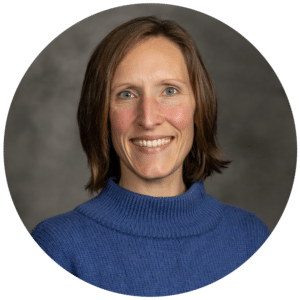
“There are also barriers to getting this medication. People need a primary care physician, transportation to the pharmacy, insurance and/or a copay, “says Dr. Eliza Hutchinson, the Warmline’s physician director. “It’s not easy to get this medication, and we know that if someone is able to start buprenorphine the same day they want to, they’re seven times more likely to start it than if they have to wait a day for it.”
Hutchinson also helped start a low-barrier OUD care facility in Seattle, Washington prior to moving to Michigan. The idea for the Warmline came several years ago when medical providers stressed the huge gap between people who need buprenorphine and access to the medication — only one in four people with OUD are offered buprenorphine.
“Buprenorphine is a daily medication that is safe to take, and it can be administered in multiple types of environments,” Hutchinson says. “It’s a partial opioid agonist that sits on the receptors in the brain where it can level off the effects of opioids. In other words, it stimulates the receptors just enough to prevent withdrawal, but it reduces cravings in those who suffer from OUD.”
The spark
Several years ago, the Michigan Department of Health and Human Services asked OPEN to provide a service that would allow individuals to receive a prescription for this medication over the phone while also connecting them to a local, long-term care provider.
While the Warmline has been advertised mostly to people recently released from prison or under the supervision of the Michigan Department of Corrections, the staff does not turn away anyone who reading out for help.
“There is a specific need for help for people being released from prison or jail,” says Hutchinson. “We know that the highest risk for those individuals is two to four weeks after their release. In fact, those individuals are at a 12-times higher risk of death two weeks after being released than anyone else in the community, and the number one cause is overdose.”
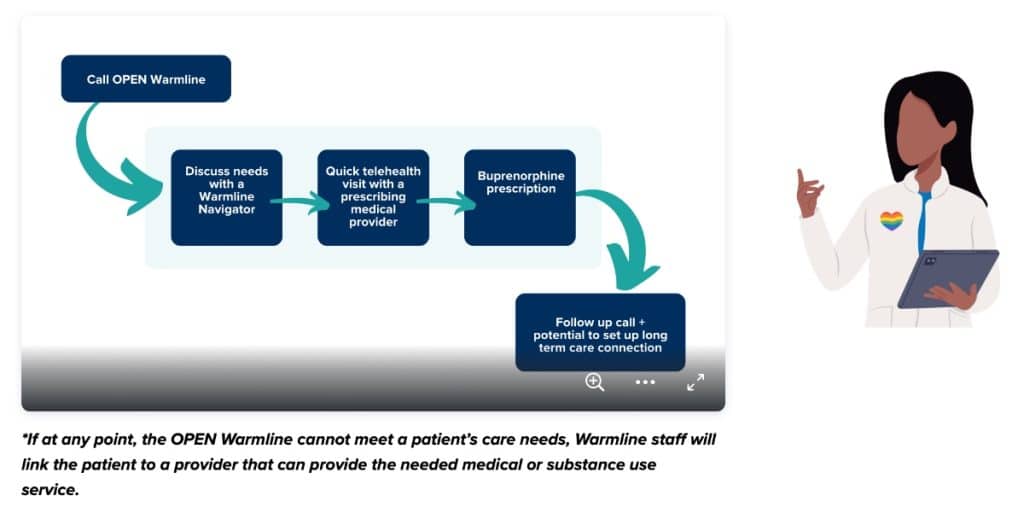
The OPEN Warmline works like many telehealth services. Someone in need calls the Warmline and is welcomed immediately by a trained mental health professional who first ensures that the caller is looking for OUD care. Next, they are connected immediately with a medical provider — a physician, nurse practitioner, or physician’s assistant. After a short visit that focuses on the caller’s OUD, the medical provider determines if buprenorphine is an appropriate treatment. If it is, they send in a prescription.
Next, the caller is transferred to a trained care navigator who helps them talk through how to continue care and overcome potential barriers — insurance, transportation, payment, and a local provider. If the caller doesn’t have a long-term care provider to prescribe buprenorphine, the care navigator will help them find one. A few days later, the care navigator follows up with the caller.
“Most of us know someone who suffers from OUD or will. We have lifesaving treatment out there. We want everyone who needs it and wants it to have access to it,” Hutchinson says. “It’s important that we offer this help in a low-barrier and nonjudgmental environment.”
To contact the OPEN Warmline before its 2026 launch, email OPENwarmline@med.umich.edu.
Photos courtesy OPEN Warmline.
The MI Mental Health series highlights the opportunities that Michigan’s children, teens and adults of all ages have to find the mental health help they need, when and where they need it. It is made possible with funding from the Community Mental Health Association of Michigan, Center for Health and Research Transformation, OnPoint, Sanilac County CMH, St. Clair County CMH, Summit Pointe, and Washtenaw County CMH.
Related Articles
Children’s mental health: When and where to access care
Local CMHs, CCBHCs, and primary care providers can serve as critical starting points, connecting children to mental health care.

LifeWays: Why Infant Mental Health Matters
How infants and toddlers are cared for impacts their lifelong mental health.

Policies, programs, and research shaping maternal mental health care
How the Center for Health and Research Transformation is working to improve mental health for pregnant and parenting individuals.