The wheels on the bus go ’round and ’round: Grand Rapids’ Central Station Early Childhood Center
The Rapid takes mom and dad to work -– and the littles to a brand new daycare opening in September 2026.
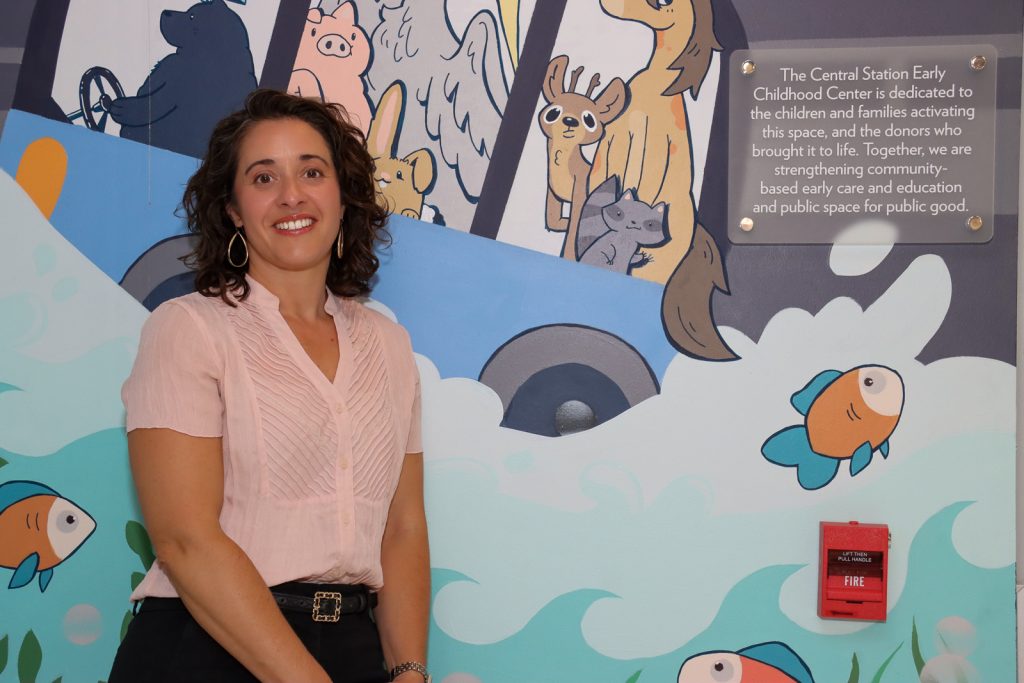
In 2021, Deb Prato started her job as CEO of The Rapid Transit Authority, Grand Rapids’ public transportation system. She looked around Rapid Central Station and noticed a lot of vacant space, space that had been vacant for 20 years.
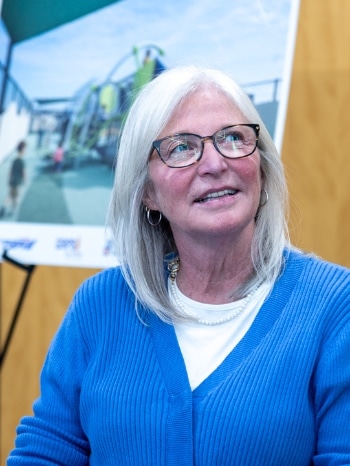
When Tracie Coffman heard that Prato was looking for ways the public could use vacant space on the second and third floors of Rapid Central Station, her wheels started turning. She texted her team at the W.K. Kellogg Foundation (WKKF), “This building is about to come open. What if we consider a childcare center here?”
The 12,000 square-foot space is now home to the Central Station Early Childhood Center.
“The Rapid is offering it rent-free. We have to pay utilities because it needs to be cost neutral for the Rapid, but there is no rent associated with it,” says Coffman, WKKF program manager and member of The Rapids’ board of directors. “Deb really felt as though the community had already paid for this building and deserved to be a community benefit. Again, public space for public good.”
A single parent of triplets, Prato understands the challenges of transporting children back and forth to school, appointments, and childcare.
“Leaders like me always hear about the three most difficult things: finding a job, who’s going to take care of children, and how am I going to get there,” Prato said at the Center’s June 8 ribbon-cutting. “We’ve combined the opportunity to solve two of those issues.”
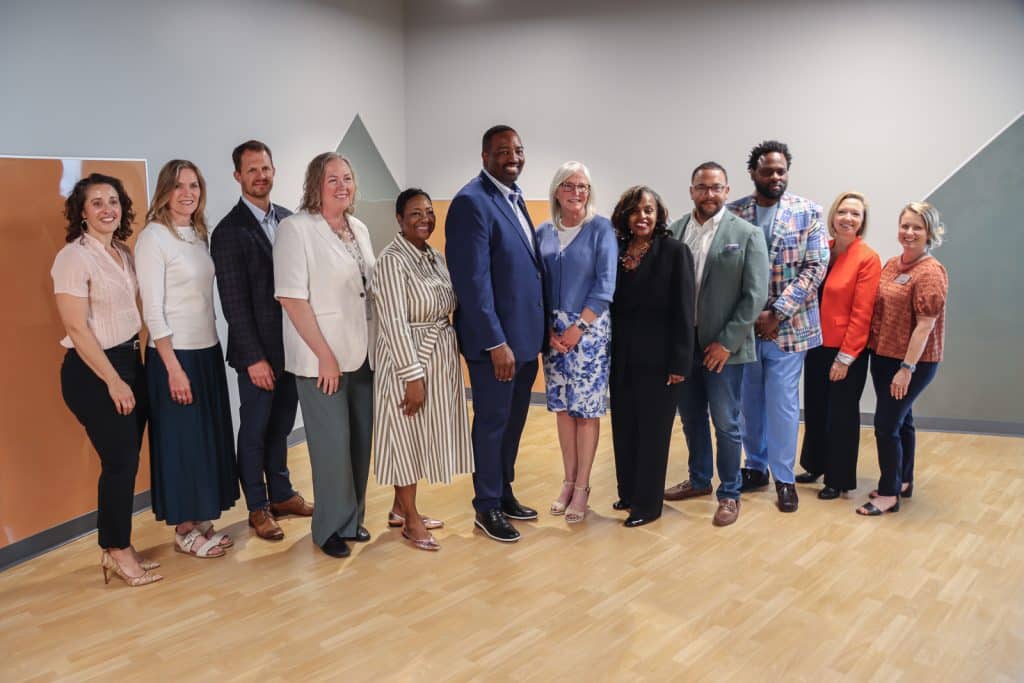
When Prato says “we,” she’s referring to the collaborators –– enough to fill a city bus –– who brought the Center to reality. In the driver’s seat, WKKF saw the center as a model for solving multiple community problems simultaneously. Others on board include Grand Rapids Public Schools, Head Start for Kent County, Pure Architects, and YMCA of Greater Grand Rapids.
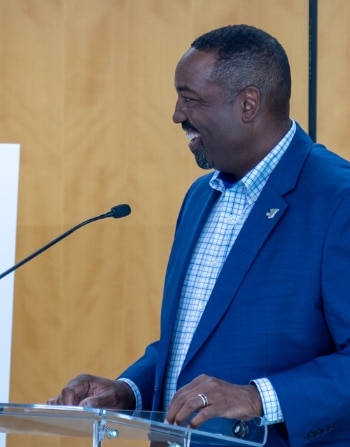
“When we first started kicking around the idea –– buses, babies, breweries [Founders Brewery is across the street] some way, somehow … we made it work,” Prato said.
YMCA Greater Grand Rapids President and CEO Scott Lewis took the podium and concurred.
“Quality early childhood experiences impact educational success, health, confidence, and long-term economic opportunity,” Lewis said at the Center’s June 8 ribbon-cutting. “Families need safe, nurturing, accessible environments to ensure that children get the best start possible. The creation of this center within the center transit hub will remove barriers from 100 families.”
“Before I came to the legislature, I was a caseworker who helped folks navigate challenges that kept them from having success in the workplace. The number one and number two issues that most people brought up in our conversations were lack of transportation and lack of accessible childcare or early childhood education. The Rapid Central Station will check both of those boxes for 100 families.” Michigan Senator Winnie Brinks
Families first: Studies find a need and parent/rider support
A 2023 IFF study found that Kent County had a deficit of 20,500 childcare slots: In Grand Rapids 7,239 slots, Wyoming 3,397, Kentwood 1,538, and Gaines Township,1,191. All of these municipalities are served by The Rapid –– and Coffman is well aware that transportation is one of the barriers families face in accessing early care and education.
“Rapid Central Station was the first LEED-certified bus station in this country. It is a beautiful building –– not the image in your mind when you picture a city’s central transit building,” Coffman says. “Knowing WKKF’s focus on early care and education, knowing we had this study that showed that neighborhood was a high need area and that transportation is a barrier, putting a childcare center there would serve a multifaceted solution for families addressing multiple needs.”
Next, WKKF set about surveying parents riding the Rapid’s buses to gauge their interest in a child care center at Central Station –– 94% of those responding rated proximity to transit as important or very important.
“We received overwhelming feedback. ‘Yes, please! When can this happen? How can we access it?’ We definitely received confirmation from riders themselves that this was a need for them and something that they would find beneficial,” Coffman says.
Five years in the making
The route was not an easy one. But after five years and $9.6 million, the Center became reality. Initial funding came from The Rapid, Grand Rapids’ Downtown Development Authority, and a $1 million federal appropriation. WKKF and the YMCA led a capital campaign that inspired an additional 17 funders to surpass the amount needed.
While the cost was high, the Center serves as a model for using public space to increase the availability of child care options. Coffman hopes this model will inspire communities throughout Michigan and across the nation at a time when childcare costs are skyrocketing. The average cost of child care in Michigan is $13,454 a year, $1,121 per month.
“We look beyond the 100 slots, that is the surface of what this childcare center is bringing. We have three entities under one roof working together in a new way to provide services to children and families in Grand Rapids” Coffman says. “The uniqueness of this center is not just its location, but the fact that it is a public building. Those are broader conversations that other communities can be having.”
Detours along the way included a new state childcare licensing structure that had not anticipated such a project, a state-mandated air modeling study due to the Center’s proximity to bus exhaust and Founders Brewery emissions, and fire safety regulations that required fireproofing every single steel beam in the building. The state also required installation of an additional elevator so children would not have to traverse spaces shared with bus riders. In all, these delays and requirements cost an additional $1.5 million in unplanned costs.
“This center demonstrates that transit systems can play a key role in development and a broader role in the community,” Coffman says. “This is a game changer. This is out of the box thinking.”
“Affordable childcare and the ability to get to and from work is this increasingly heavy financial strain that families –– huge lifts for families in many communities in our state, and Grand Rapids is no exception.” Former Grand Rapids Mayor and former Rapid Transit Authority board member Rosalynn Bliss.
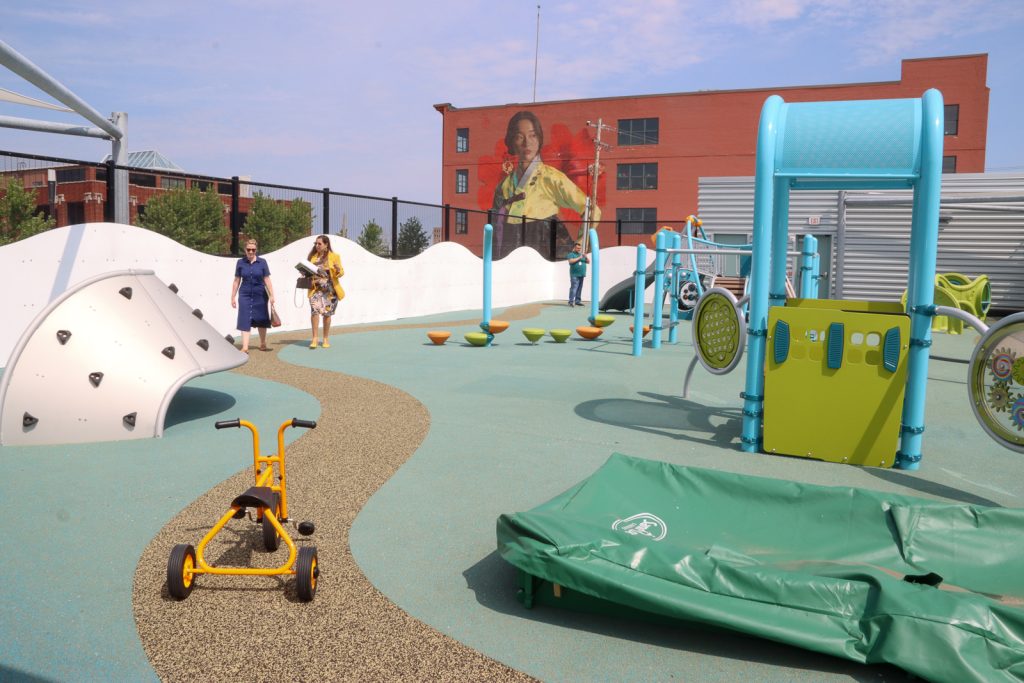
Little tables, little chairs, playground in the open air
Serving ages six weeks through five years, the center offers multiple options for families based upon their ability to afford care. Parents can enroll kids under four years of age by contacting the YMCA of Grand Rapids Child Care office. Four-year-olds can be enrolled through the Grand Rapids Public Schools Great Start Readiness Program (GSRP). Priority will be given to families that use The Rapid to commute to work.
“The partnership with the YMCA, the Grand Rapids Public Schools –– who will have GSRP slots –– and Head Start, means there’ll be a variety of scholarships available to families,” Coffman says. “About 75% of families will have scholarships attached to their slots and about 25% attending will be full pay.”
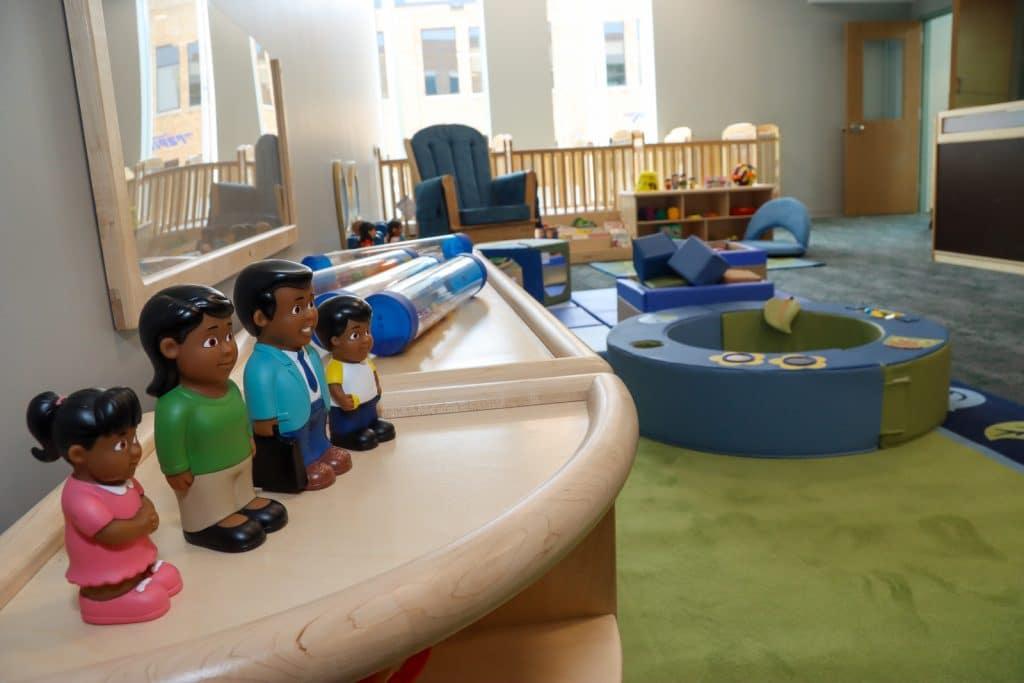
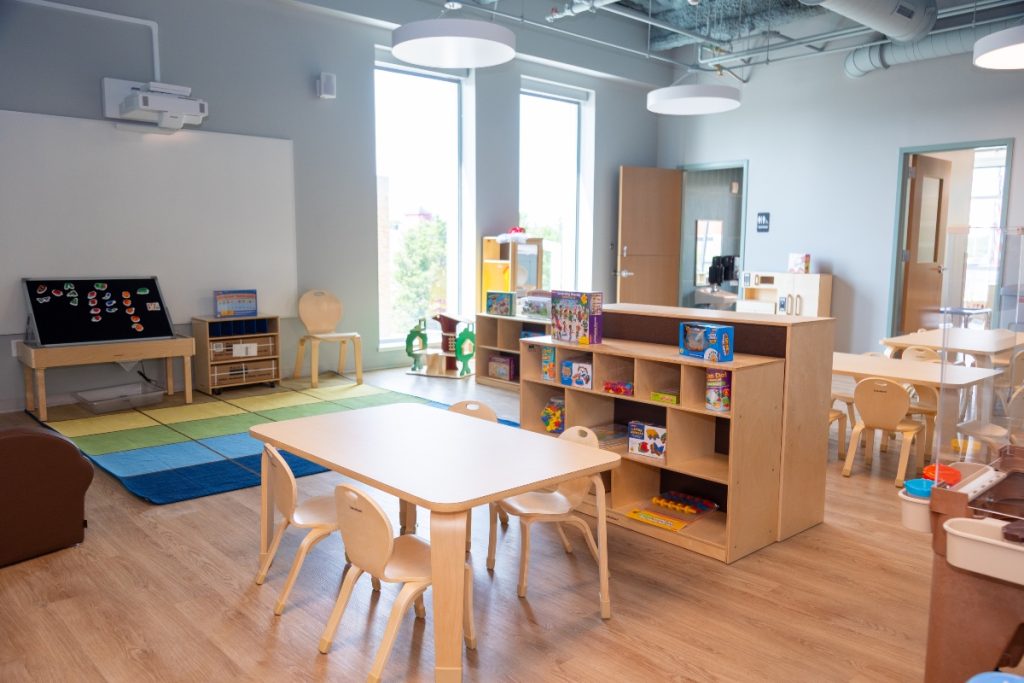
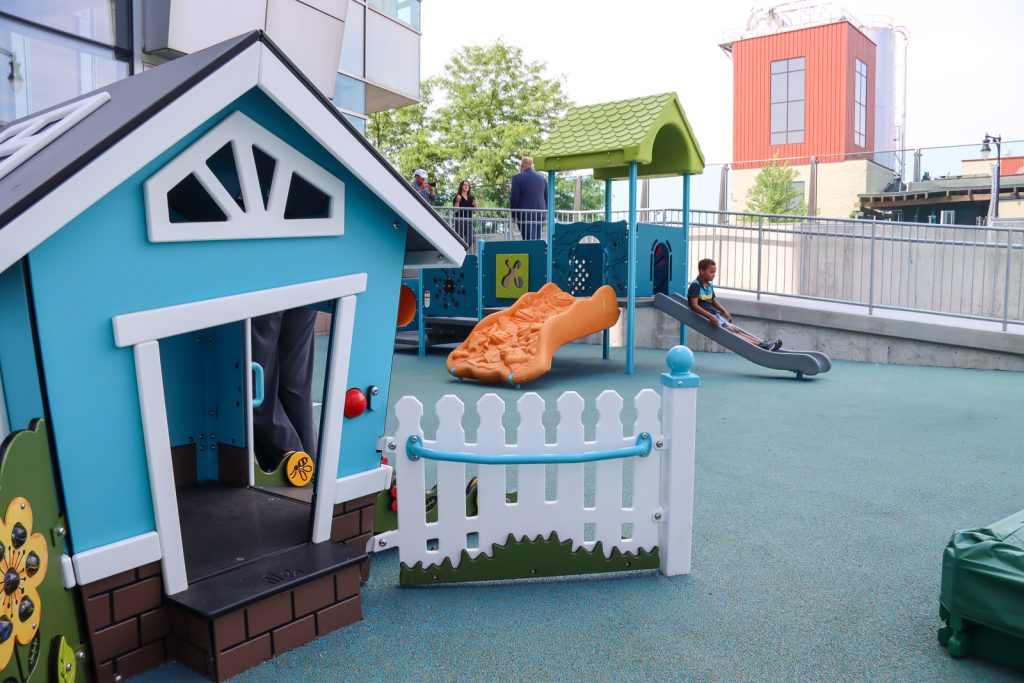
The classrooms are ready. Natural light spills through large windows that give expansive views of the city –– like Richard Scarry’s book, “Busy, Busy Town.” On the second-floor infant and toddler area, trendy wood cribs and rocking chairs await the tiniest babes. On the third-floor, adjacent to the older children’s classrooms, a very safe rooftop playground provides fresh air, sunshine, and fun.
“We cannot talk about early care without talking about how families access it, and a major barrier to access is transportation,” Coffman concludes. “We need solutions that can address multiple barriers simultaneously and provide multiple solutions, because that’s how families lead their lives.”
Photos by Tommy Allen.
Photos of Scott Lewis, Deb Prato, and preschool classroom by Isabel Media Group.
Early Education Matters shares how Michigan parents, child care providers, and early childhood educators are working together to create more early education opportunities for all little Michiganders. It is made possible with funding from the W.K. Kellogg Foundation.
Author
Related Articles
Navigating autism now more difficult for Michiganders
Autism Alliance of Michigan has laid off 75% of staff due to unexpected state funding cut.
U.P. tour helps historical communities build a stronger economic future
Michigan Municipal League travels north to share resources for small business development.
Battle Creek preschool creates culturally affirming foundation for kindergarten
Students and families feel seen, supported, and connected.