Detroit Public Schools intent on feeding kids healthy meals in face of impending SNAP cuts
Changing federal policy impacting qualifications for SNAP benefits means more Michigan families will not be able to afford food.

Changing federal policy impacting qualifications for SNAP benefits means more Michigan families will be unable to afford food, especially healthy food. When families are undernourished, so are their children. This means free and reduced meals being offered at Michigan’s schools will become even more vital to children’s health — physical and behavioral — and academic performance.
MI Families recently spoke with Sharlonda M. Buckman, Detroit Public Schools Community District chief external engagement officer, about how impending SNAP cuts make free school meals even more important.
Q. How many children attending Detroit Public school community district receive free meals?
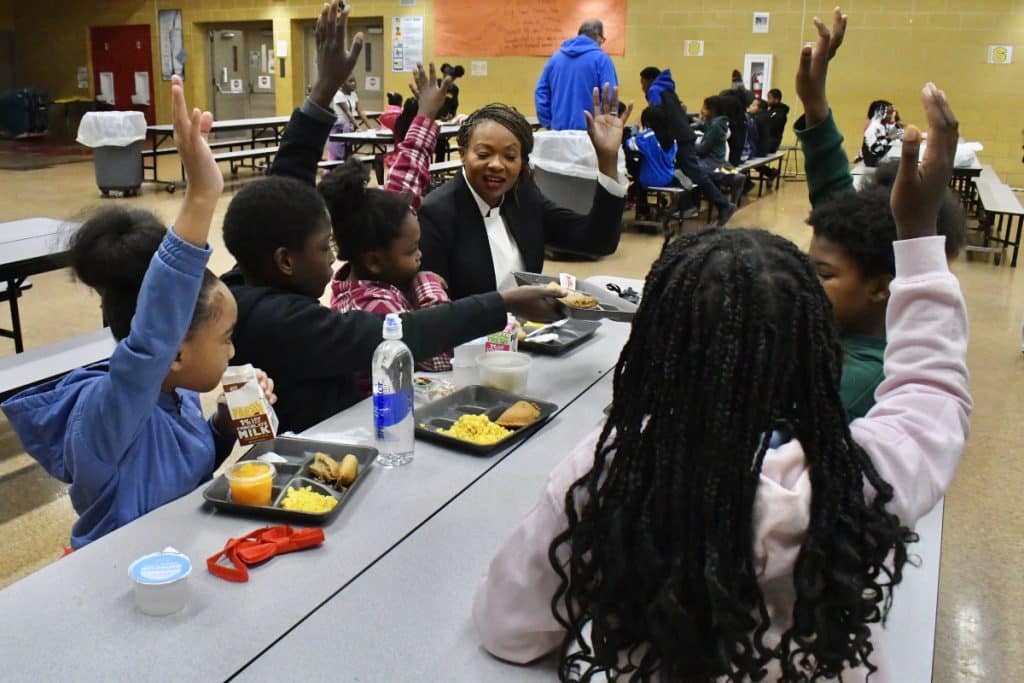
A. About 80% of our students receive free and reduced lunch, right now, within our school district. We’ve got roughly 50,000 students, so that would be about 40,000 students — a lot of kids.
Q. How do the meals benefit the kids as well as the school environment?
A. The concern and the urgency is around making sure we provide not just meals but healthy, nutritious, balanced meals is critically important. It’s very expensive raising a family these days. Everything is going up… it hits families who are on the lower spectrum, low income, grappling with issues of poverty. It hits them so much harder. Meals in the school for our children help to supplement our families so there’s less economic stress for them because there are at least two or three meals that they can count on coming from the school.
Obviously a healthy meal puts children in a better place to learn. They aren’t dealing with hunger in school. They’re more ready to learn. Their behavior is generally better because they’re having a balanced meal, and there’s a safety and security in it. Children do better when they are in a place of learning where their basic needs are met, and food is a basic need.
Q. If children were unable to eat these free meals at school, how would that impact them academically?
A. No matter the politics of the day, children need to be held harmless, and unfortunately, we don’t always see that. I’ve watched some of what’s happening with the SNAP benefits. Our children will still receive free breakfast, free lunch. We have snacks in schools, as well. We also have some schools that are providing dinner in terms of after-school programs. Our expectation is that, regardless of what happens with the SNAP benefits, we’ll continue to provide that service. What I worry about, depending on what happens with these policies and how they hit states, is our ability to continue to be able to identify economically disadvantaged children that qualify for SNAP benefits and, long term, will that hurt our funding? But the immediacy and the expectation is that we will continue to provide those meals to students.
When there was a brief SNAP pause, we had a few of our funding partners actually lean in and support supplemental meals. During this last winter break as well as spring break, we were able to provide almost 5,000 families throughout our district with additional meals. We’ve always found a way to try to close the food insecurity gap. I can’t say we close it completely, but certainly, we’ve played a role in that. Food is a serious issue in terms of basic functionality.

Q. How will families losing their SNAP benefits impact them overall?
A. It definitely makes the meals that we provide even more critically important. As adults, when you miss a meal, you don’t focus as well and things become unraveled. It puts families in distress. It further destabilizes families, which is already an issue when a large percentage of our families are below the poverty line. Not having basic nutrition could lead to other health disparities that negatively impact our children and our families. If they have elders living at home, sometimes it brings on additional sickness and problems that require the children to not be in school, further exacerbating the issue of chronic absenteeism. It has a domino effect across a number of issues that get exacerbated when children don’t get their basic needs met, such as food.
Again, it is about making sure that we cover children’s basic needs, regardless of what adult statuses are. That’s what America should represent. That’s what our communities should represent — making sure children get their basic needs met. In my hometown and state, Michigan and Detroit, we are optimistic that we’re going to put children first and hold children harmless in the politics of the day. Our state government has been great with that and supporting education. Our expectation is that they’ll continue to do that.
The conversation changes if families no longer receive SNAP benefits. That’s a longer conversation and strategy to figure out how do we make sure that our families are not further destabilized because of bad policy.
Photos by Leslie Cieplechowicz.
MI Families shares the work of community organizations, healthcare providers, educators, employers, and other Michiganders as they work to create better health, educational access, and economic security for all Michigan families. It is made possible with funding from the W.K. Kellogg Foundation.
Author

Related Articles
This neighborhood accelerator strengthens community in the digital age
The FORT-ify Neighborhood Accelerator empowers local associations with connections to funding, resources, and face-to-face engagement opportunities to build stronger communities.

Historic properties are prime candidates for residential and mixed-use developments
The revival of legacy commercial, educational and manufacturing properties embraces sustainability, technology and adds housing.

Partner Partner Content Five years in, this wind park’s revenue is reshaping local school and farm finances
Five years after Michigan’s largest wind farm began generating power in Isabella County, its economic effects are becoming clearer. A new analysis finds the project is generating millions in estimated annual lease revenue for landowners while expanding the tax base for local school districts, helping some pay down debt and improve facilities.