North Central Michigan College plans to launch northern Michigan’s only dental hygiene school
Over the past three years, North Central Michigan College staff have been working on building a dental hygiene program, designing a new facility to house it, and seeking funding to get it off the ground.
This article is part of State of Health, a series about how Michigan communities are rising to address health challenges. It is made possible with funding from the Michigan Health Endowment Fund.
When Stephen Strom joined the staff of North Central Michigan College (NCMC) in 2021, he was surprised to experience major challenges making an appointment to get his teeth cleaned near his new workplace in Petoskey. When Strom, NCMC’s vice president for academic and student affairs, discussed that struggle with his colleagues, they saw an opportunity to help solve a big problem. Michigan’s Upper Peninsula and northern Lower Peninsula have a drastic shortage of dental hygienists, driven in part by all the state’s dental hygiene schools being located in the Lower Peninsula’s southern half.
“Lo and behold, up North, it’s not unusual to wait 12 months or more to get your teeth cleaned,” says NCMC President Dr. David Finley. “And so we identified the challenge, the problem, the opportunity, whatever word you want to use, and really worked over a number of years to dial it in as a viable program.”
Over the past three years, NCMC staff have been working on building a dental hygiene program, designing a new facility to house it, and seeking funding to get it off the ground. Since receiving approval from the NCMC board in December 2025 and the Higher Learning Commission in June this year, staff have been moving full steam ahead to launch the program in fall of 2028.
NCMC Gift Officer Jenny Johnson says the program can’t start fast enough for the local dental hygienists she’s spoken to, who have asked her “why [NCMC] can’t graduate people today.”
“They’re in such a desperate need for hygienists,” she says. “They can’t grow their businesses. They can’t accommodate their current patients, much less get new patients in the door. So they are just euphoric that we’re launching this school.”
Severe shortage of dental hygienists
NCMC staff cite statistics from the Michigan Center for Data and Analytics showing that the state needs 545 dental hygienists annually. However, the state’s dental hygiene programs graduate only 353 hygienists per year – and the northernmost of them is Ferris State University’s program in Big Rapids.
“Right out of the gate, we’re in essence 200 professionals short per year,” Johnson says. “And so the only way that we’re ever gonna accomplish anything is to open new schools, because we simply do not have the capacity to teach and train more hygienists.”
Rico Breznau, NCMC’s dental hygiene program director, says most colleges are hesitant to open a new dental hygiene school because they’re very expensive to establish and maintain. But in her 44 years working in the dental field in Michigan, she says additional schools are needed now more than ever.
“It has increasingly, every year, gotten worse as far as the availability of dental hygiene appointments,” she says. “And I think when COVID happened, we also had a lot of the hygienists that were nearing retirement, but not planning to retire yet, retire from the profession early. And that added additional burden.”
Building a dental hygiene program
The past three years have entailed quiet but intense preparation work on the dental hygiene program. Breznau has been hard at work conducting feasibility studies and pursuing accreditation from the Commission on Dental Accreditation, the latter of which was funded by a grant from the Michigan Health Endowment Fund. NCMC staff have treated the college’s successful nursing program as a model for the dental hygiene program. The nursing program, launched in 1964, began with a small class of 16 students but has become a community fixture. NCMC staff plan for the dental hygiene program to also start small, with a 15-student inaugural class, and make a big impact.
“We’ll go toe to toe with any college or university in the state,” Finley says. “If you want to be a nurse, this is the place you come. And our aim is the same for dental hygiene.”
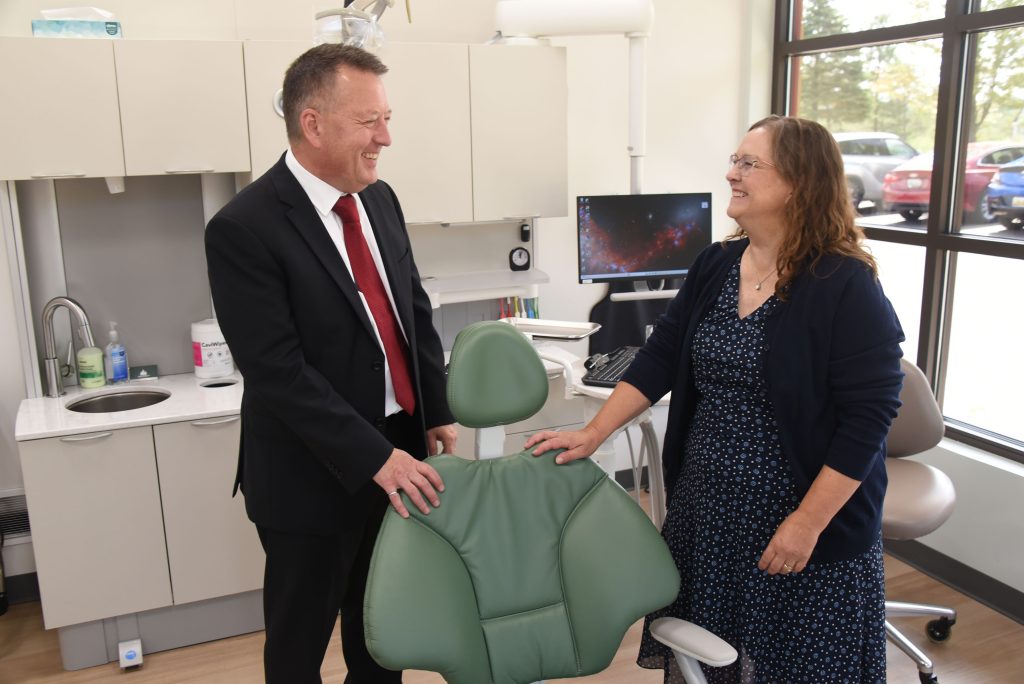
NCMC has also purchased and made plans to renovate a building about four miles west of Petoskey as the dental hygiene program’s home. The building, which has already been purchased, will include 15 student operatories, four X-ray stations, offices, conference rooms, a student lounge, and more. The facility is designed to accommodate up to 20-25 students per semester as the program grows. Finley says he expects to solicit bids for the building project this fall, begin renovations next year, install equipment late next year through early 2028, and launch the program in fall 2028.
The facility is expected to cost about $10 million dollars. Roughly a quarter of that money went to purchase the building, about half will go to construction costs, and another quarter will go to furniture, fixtures, and equipment. NCMC is slated to receive $2.5 million for the project in this year’s state budget. An anonymous local foundation has pledged a $2 million challenge grant to the project if NCMC raises that amount over this year and next. Staff are moving quickly on fundraising for the project now that they’ve received Higher Learning Commission approval.
“This really is a community effort and the only way that we’re going to get to the entire budget is through individual foundations or family gifts,” Johnson says.
Creating jobs, improving community health
NCMC staff anticipate that the dental hygiene program will have major positive impacts for their region’s job market and community health. Analysis of state and federal data shows that dental hygienists make an hourly wage of $36-$50, providing well-paying jobs for program graduates. Notably for a community whose economy relies heavily on summer tourism, those jobs are also year-round and not just limited to a handful of months.
Johnson says over 100 potential students have already reached out to NCMC requesting information on the program’s progress, including local residents who want to study dental hygiene but couldn’t relocate to study downstate.
“The impact that it’s going to have for our local learners is going to be huge,” Breznau says. “Just being able to offer something like this to our students that are in this area and want to stay in this area, it’s an opportunity that just doesn’t come along a lot in Northern Michigan.”
Beyond positive outcomes for local learners and job-seekers, NCMC staff also see a big opportunity to combat periodontal disease and its complications in their community. In addition to periodontal disease’s negative impact on oral health, it’s been linked to even more serious conditions like heart disease, stroke, and diabetes.
“Starting this program is not just about building 12-month-a-year jobs,” Johnson says. “It’s also about impacting our overall community health, which is so desperately needed. And so that’s where we feel like we’re going to make a far bigger impact on our community.”
Author

Related Articles

Dementia care navigators help Coloradans get the support they need
Launched in 2024 by the Centers for Medicare and Medicaid Services, the GUIDE model provides care and support for Medicare beneficiaries living with dementia as well as their caregivers.

COVID kids and mental health: How are pandemic littles doing today?
Mental health challenges have surfaced but kids also benefited from increased family time and less hectic schedules.

They grew up breathing Detroit air. Generations of women are pushing for new approaches to pollution.
Some are organizing and training to advocate for their neighbors; some are trying to change the laws to consider the cumulative burden of pollution.