Community Development Financial Institutions help rural Northern communities fund affordable housing, education, support small business growth
Rural communities often experience a lack of capital access due to bank mergers, or community banks leaving their areas. CDFIs step in to bridge the gap by providing crucial capital, workshops, and referrals to rural communities — funding affordable housing, high-quality education, and community development with small business growth.
Block by Block is a solutions journalism series that is supported by IFF, CEDAM and Invest Detroit, and is focused on community development leaders and initiatives in Michigan, Ohio and Indiana.
Although urban and rural communities might look a lot different physically, their baseline needs are often the same. Residents often look for high quality education, affordable housing in a walkable downtown with nearby small businesses, and a sense of community, place or belonging.
Rural communities often have a lack of access to capital due to larger banks being present, recent bank mergers, and community banks going away. Community development financial institutions, or CDFIs step in to take the time to hear about a rural community’s needs, provide referrals, technical support, and offer crucial financial investment.
Small farm businesses in Northern Michigan
In Northern Michigan, Laura Galbraith is the president of Venture North Funding and Development, which began as a ‘financial first-responder’ for businesses after the 2008 economic recession.
“We started lending to businesses having challenges during that time,” Galbraith says. “Over the past 15+ years, we have been able to expand our offerings to provide low-interest loans and no-cost coaching and consulting to small businesses in a 10-county region — up to Harbor Springs, Petoskey, down to Cadillac and all the way over to the West in Manistee County.”

Galbraith says there’s a lack of infrastructure in Northern Michigan, and a lack of broadband internet impacting residents’ ability to use online banking or apps. There’s also a lack of resources too, as professional CPAs or attorneys are retiring or don’t have the capacity to take on new entrepreneurs.
“When it comes to financial institutions, a lot of the larger regional banks serve multiple communities across Northern Michigan, but don’t have a physical presence — a branch or staff that lives in those communities,” Galbraith says. “Businesses then don’t know who to talk to, where to go to make deposits or withdrawals. For some smaller community banks and credit unions too, it doesn’t make sense for them to have a brick and mortar in these really rural villages and townships. They’re serving a 10-county region with their headquarters in Traverse City and serving communities maybe 2.5 hours away.”
Venture North’s mission is to provide opportunities and community development for people and places systematically under-financed and excluded, bridging gaps to business prosperity.
Venture North often provides micro-loans to entrepreneurs to get their first piece of equipment or small amount of working capital, working alongside them for the first three to five years. After that, they’re introduced to more traditional bank relationships and collaborative CDFIs to continue on their business’ next steps.
“As a CDFI, we’re really there to help when a bank says, ‘no’ or ‘you’re not ready yet,’” Galbraith says. “But in addition to lending, we offer free coaching and consulting — helping them with performing balance sheet and cash flow projections, marketing plans, business plans, introducing them to attorneys for contracts, lease agreements, and bookkeepers and CPAs. It’s offering those wraparound services to make them successful.”
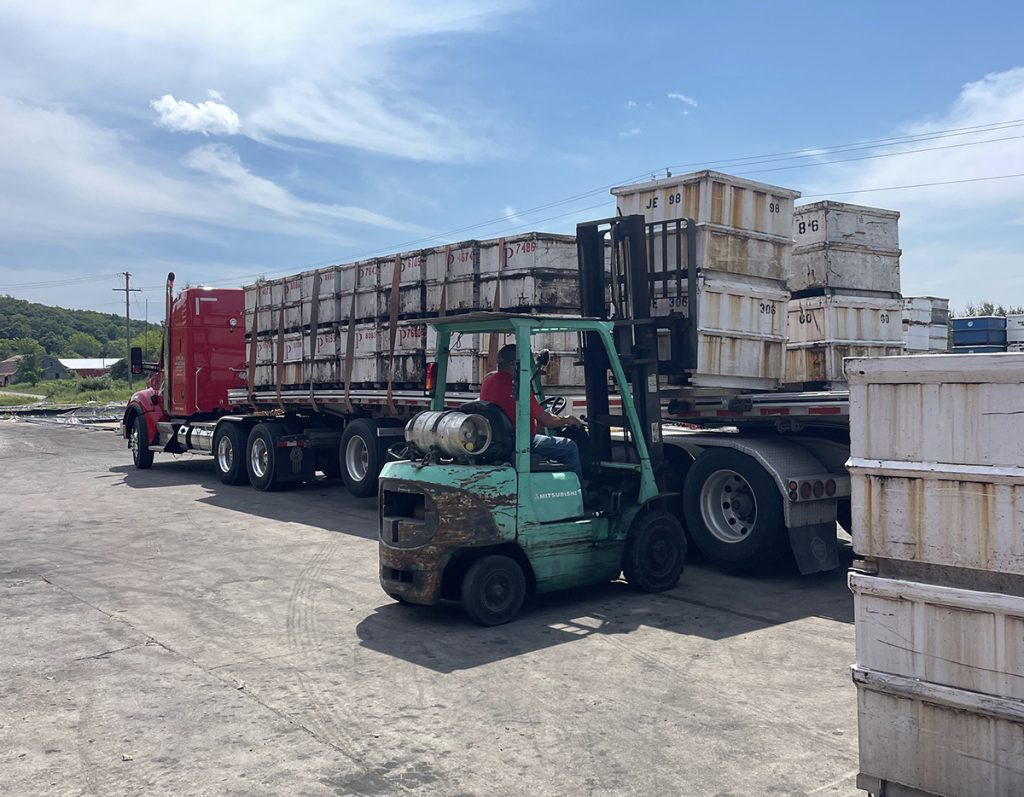
Many of the community development businesses Venture North works with are farms within the rural area, including Benjamin Twiggs.
“This is a business owner who has lived in Leelanau County for her entire life,” Galbraith says. “Her family are generational cherry farmers and the cherry farm industry is really important to our economy. Her business model is to support cherry farmers. She purchases cherries to put into various products, sells her products to different corporations and visitors of the Traverse City area.”
Venture North helped owner Leisa Eckerle move to a new larger space at 305 West Front Street in downtown Traverse City.

“Sometimes, it can be difficult for businesses to get traditional bank financing when they’re leasing space because they don’t have that brick and mortar as collateral,” Galbraith says. “This is a perfect example of a CDFI that’s able to support an entrepreneur with capital to expand into a new location. More square footage allows her to buy a few more pieces of equipment, hire a few more people, and in a location where visitors can actually see the storefront and purchase her goods.”
Location can be a barrier for folks when it comes to community development, says Galbraith. She hopes to be able to provide more workshops and face-to-face meetings with small villages and townships that are far away from the nearest urban corridor. The goal is to come to them, get through the noise, and let small businesses know Venture North and other CDFIs are there with no judgement, to help.
High-quality, unique education in the U.P.
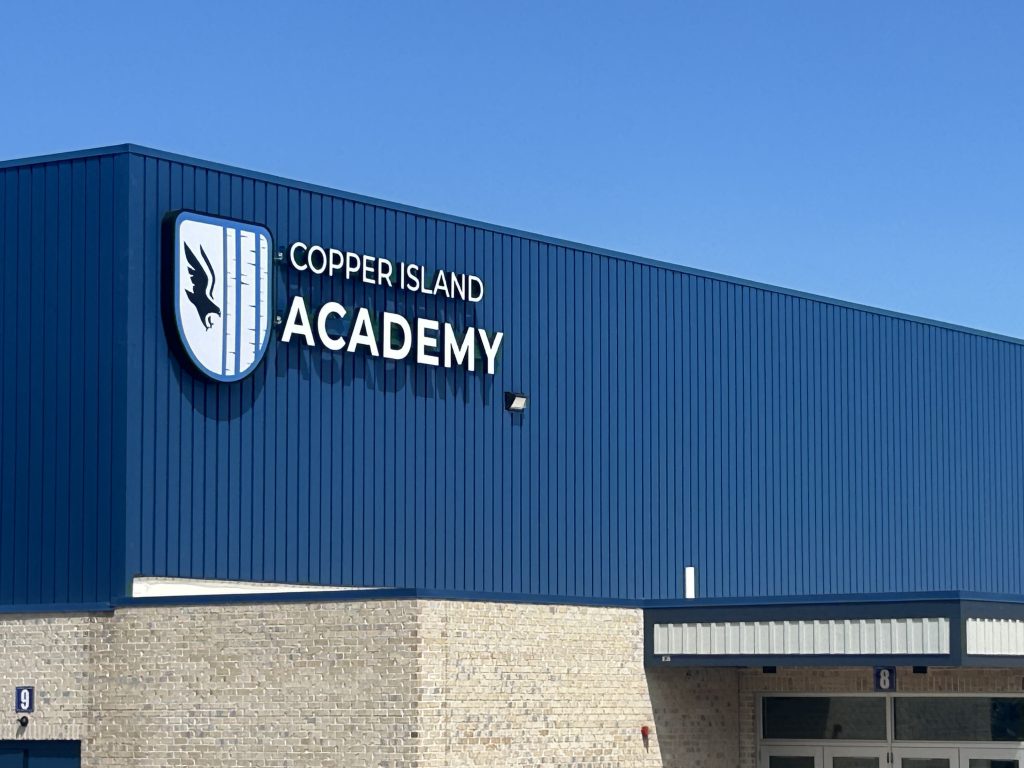
Matt Laho is the director of operations and instruction at Copper Island Academy, a U.P. charter school in Calumet. Founded after COVID in the Keweenaw Peninsula, the mission is to prepare students for college, work, and life success through a Finnish education model embracing traditional American ideals. Their model embraces innovation and tradition — using outdoor settings, hands-on learning and frequent unstructured brain breaks.
Cinnaire Lending Corporation has provided a $6.4 million source loan and $10 million of New Market Tax Credit allocation from Cinnaire New markets, which generated a $3.1 million equity investment from Dudley Ventures.
“The project will result in the construction of an 8,000 square-foot middle school to serve about 180 students and a 25,000 square-foot high school to serve about 200 students — approximately 40% of whom are low-income or reside in low-income communities,” says Chase Schulte, loan underwriter for community facilities at Cinnaire.
These building additions bring local jobs including teachers and student support staff. It also can contribute to the local economy and address population decline.
“We don’t have the ability to take a bond to the taxpayers to fund facilities,” Laho says. “We have to find creative ways to be able to add any expansion to our building. When the New Market Tax Credit with Cinnaire became a possibility, we had a lot of conversations early on and it ended up being the best way to go about it.”
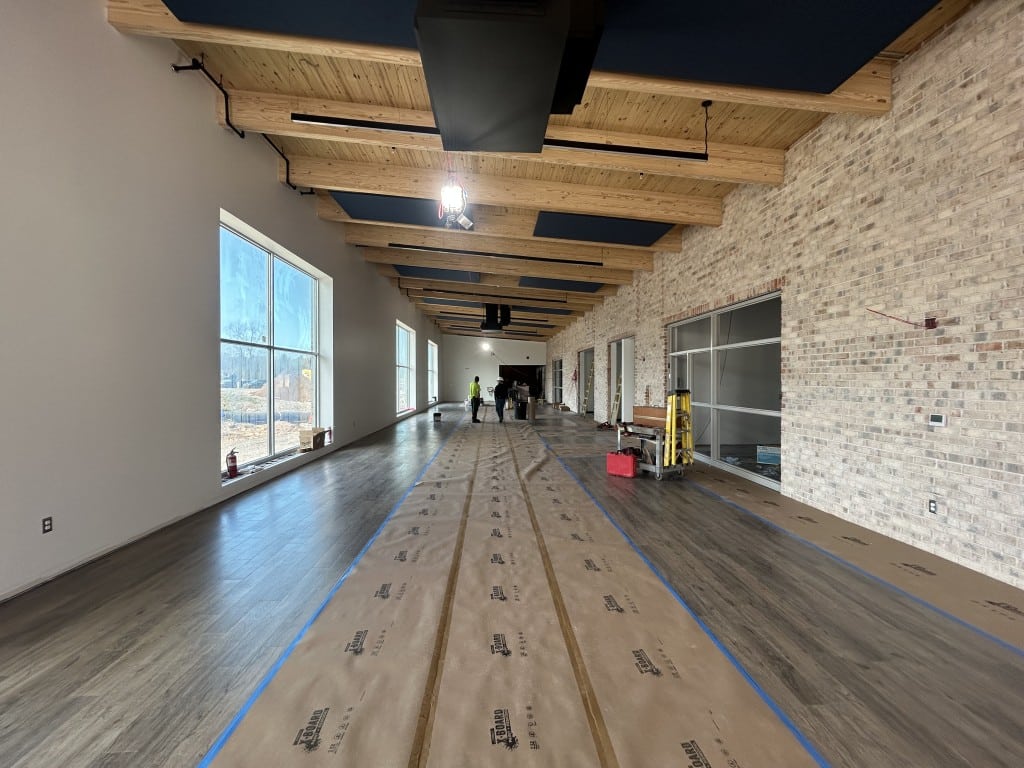
The new school space will have a large atrium used for different pathways including instruction use, lunch time, and an entrepreneurial school store setup. Other classrooms will be used for healthcare instruction featuring hospital beds, as well as a large skilled trade center housing metals, manufacturing and construction trades. There will also be a STEM lab space for robotics and pre-engineering.
“The goal is to help retain talent and strengthen the economy,” Laho says. “We have a meeting group with local community business leaders, kind of a steering committee for those high school pathways. We get real-world feedback on what they’re looking for, what they need, and what skills we need to develop into these students. We integrate that into our educational model so they can be successful in the community.”
“The interesting thing about this deal is that it really highlights the lack of capital available in rural areas,” Schulte says. “When we started working on this with the borrower, we did not plan to make a loan into this deal. They had identified a community bank that had partnered with the construction company. Unfortunately, that bank did pull out about halfway through the project. Cinnaire stepped in to provide that $6.4 million loan. Without us, I’m not sure if this deal would have gotten across the finish line, there are few lenders who could have stepped in that really quick timeframe and have gotten it done.”
While CDFIs play a role in these impactful projects, Schulte considers the heroes of the deals those people who are on the ground in these communities — the construction companies combined with the committed and engaged community partners.
Middle-income housing for rural Northern Michigan communities
Stacy Esbrook is vice president of policy and impact at Michigan Community Capital (MCC), a 501(c)(3) community-development focused nonprofit that develops middle-income housing with for-sale homes and rental units in mixed-use downtown developments. She’s in charge of collecting impact data, managing relationships through elected officials and industry coalitions like the Detroit CDFI Coalition and Michigan CDFI Coalition.
MCC invests in both urban and rural communities, providing capital to projects where traditional lenders have constraints in terms of their ability to lend. Sometimes their physical location might be a bit removed from the service area, making it harder to find resources. Other times, a lender might not be familiar with the product or market of the intended borrower, deeming the loan too high-risk. Esbrook says CDFIs like MCC are great additional tools that can help make these project blueprints and inventive ideas a reality.
“We provide technical assistance, helping developers figure out how to make their projects make financial sense — bringing in a local tax abatement, a Brownfield tax increment financing plan, various grants or loans throughout the state or country,” she says. “We help piece together the tools that make our loan and the project financially feasible so that when it’s done, it will be successful for years to come.”
One project that’s been years in the making just celebrated its ribbon cutting ceremony earlier this month. Located in Downtown Grayling, Sawmill Lofts is a $18.3 million mixed-use development with 40 apartments and commercial space at 102 Michigan Avenue. Previously contaminated and blighted parcels, a colorful, five-story, almost 36,000-square foot building stands tall today.
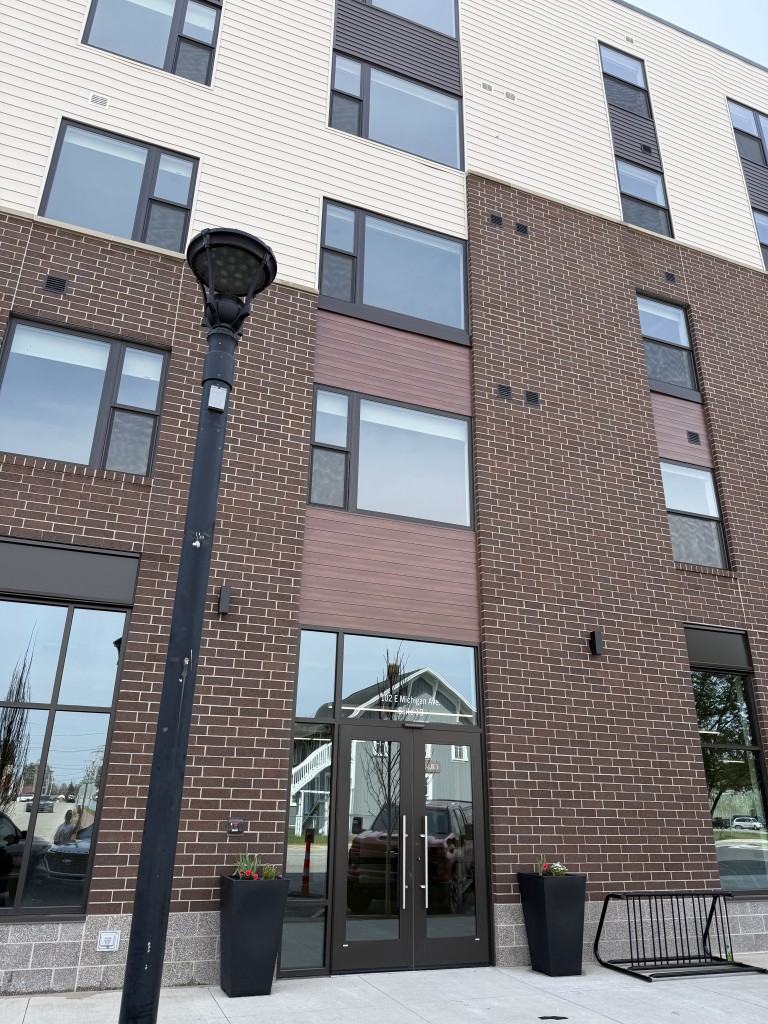
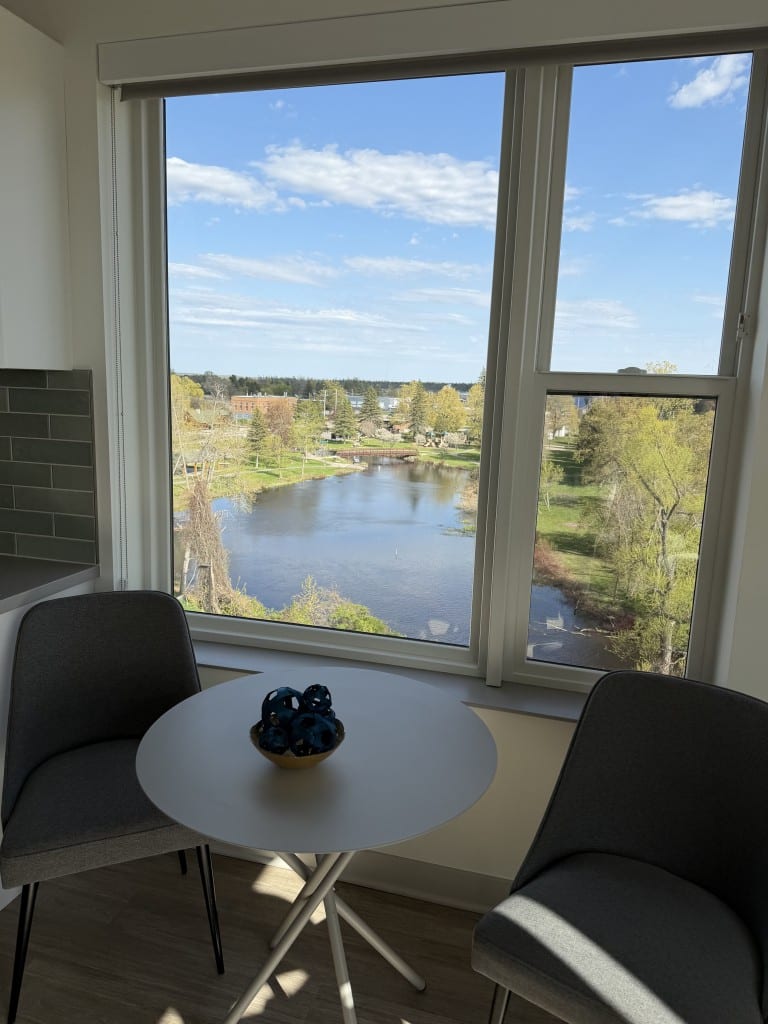
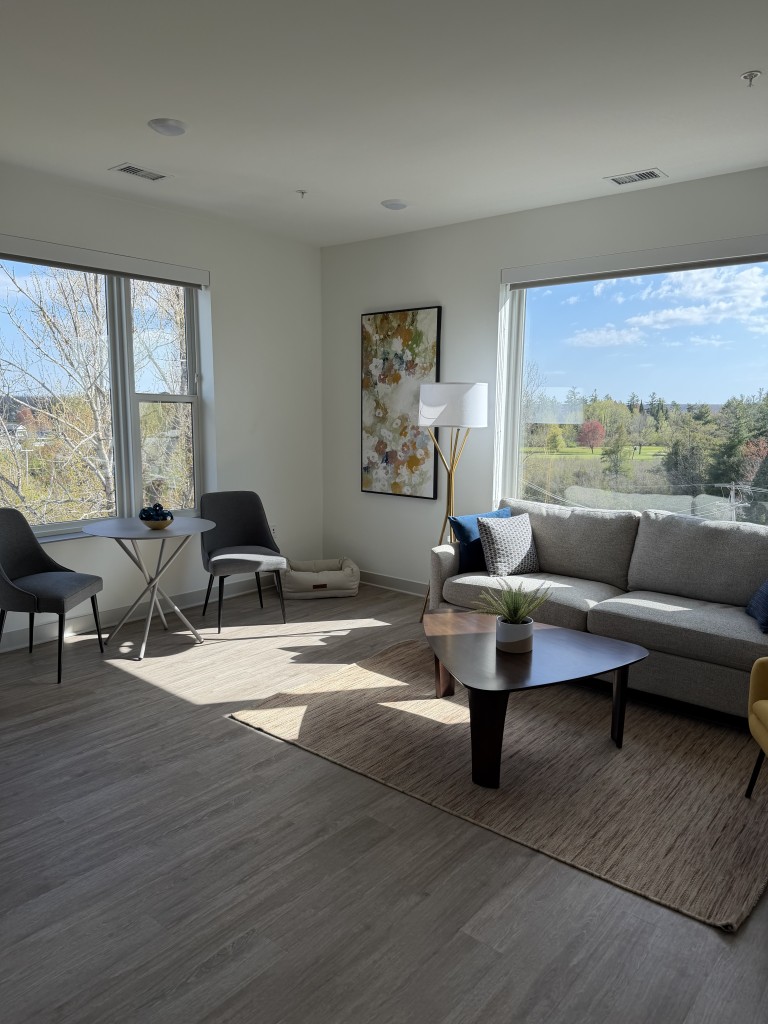
The project was a long time coming, and experienced setbacks during the COVID pandemic when construction costs surged, impacting potential development in rural areas even more.
“The challenges are exasperated in rural communities because the rental rates are already lower than those in urban areas, but the costs of steel, wood, light fixtures and toilets cost the same whether you’re putting them in Ann Arbor or Grayling — but you can’t charge the same rent,” Esbrook says. “Making sure you’re bringing enough revenue to pay your bills is a function of bringing in the right financial tools as well.”
Celebrating at the ribbon-cutting ceremony was a proud accomplishment for Esbrook and other collaborators behind-the-scenes.
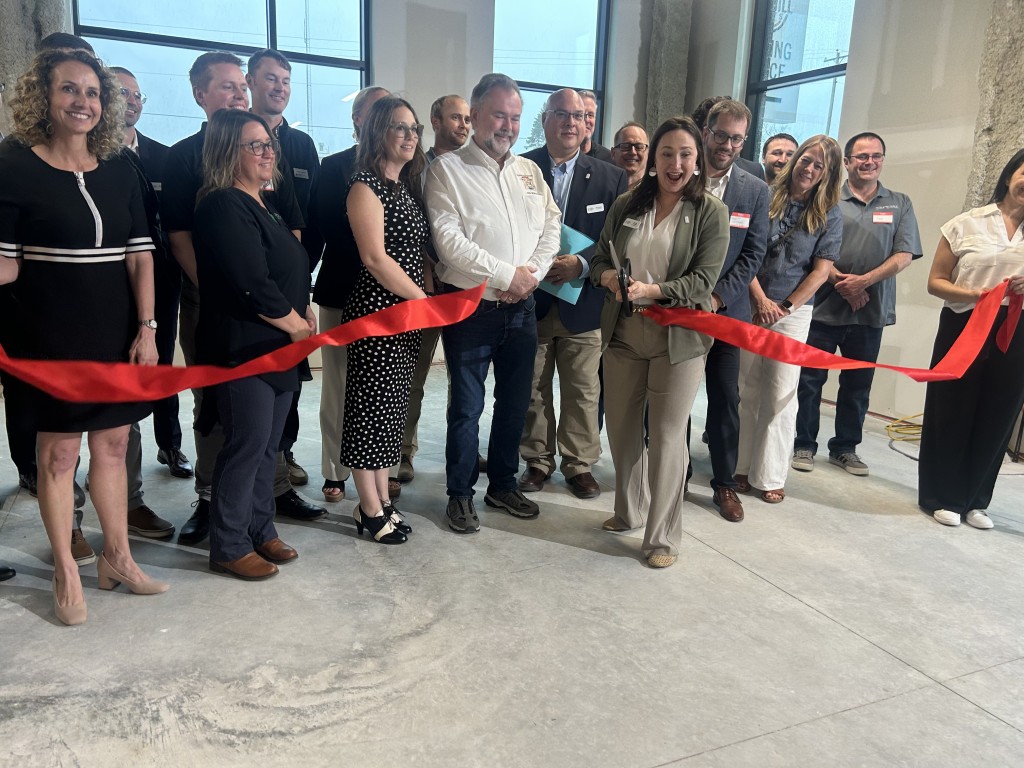
“It’s now the most-expensive and largest development in Downtown Grayling,” she says. “We were able to get the project over the finish line because we partnered with the Michigan Economic Development Corporation, the Michigan State Housing Development Authority, as well as the Michigan Department of Environment, Great Lakes, and Energy. Each of those organizations financially contributed to the project as well as the local county which provided a Brownfield tax increment financing plan.”
The studio, one-bedroom and two-bedroom apartments address a gap in housing for working families in Crawford County — those earning 60-120% of the area median income. Rent starts at $885 per month for energy-efficient units featuring stainless steel appliances, in-unit washers and dryers, and large windows. A large 40-foot mural adorns the exterior, while inside the lobby features art from the AuSable Artisan Village showcases the region’s river, landscapes and wildlife.
Within region 3 (Onaway, Alpena, Grayling, etc.), MCC has invested $36 million, facilitated 36 permanent jobs, rehabbed or created 104,810 square feet, and financed 40 housing units.
Esbrook hopes to see more projects like this in rural areas, but the programs used to fund these are no longer being offered from the State of Michigan, and the federal money has dried up.
“As a kind of a coalition of partners, we’re trying to revive an old community development tax credit that will help fill in gaps so projects like Sawmill Lofts will be able to happen throughout Michigan,” she says. “There’s currently legislation proposed at both the House and the Senate that we’re trying to garner support for. Projects like Sawmill Lofts don’t happen without tools, and today we don’t have any tools. Unless the Legislature acts and brings back the tax credit, projects like this will just not happen. We can replicate this in other rural communities in Michigan so long as we have the tools to do it.”
Related Articles
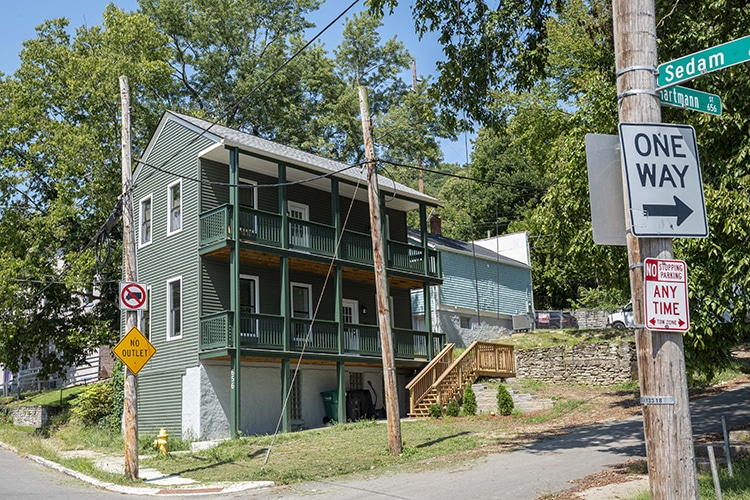
Restoring a Cincinnati neighborhood one historic home at a time
An $8.4 million investment is bringing homeownership and a renewed sense of possibility to one of Cincinnati’s smallest neighborhoods.
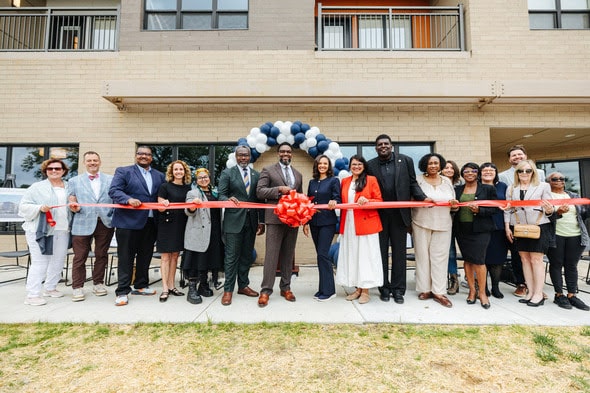
Minock Park Place provides new affordable senior housing for Detroit’s older residents
In the heart of Detroit’s Grandmont Rosedale neighborhood, a 42-unit, mixed-use development has given senior citizens brand-new affordable housing. Minock Park Place was seven years in the making, and marks the first affordable senior housing community in the neighborhood, located at 19505 Grand River Ave. — a vital commercial and cultural artery.
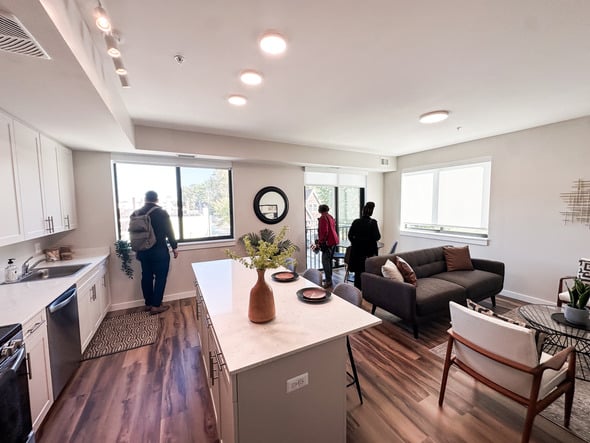
Detroit Housing for the Future Fund returns to drive affordable housing, stable neighborhoods
The second phase of the Detroit Housing for the Future Fund (DHFF) returns, offering communities across the city the opportunity for more affordable, stable neighborhoods.