Free Cleveland clinic brings free dental care and more to patients
Volunteers at MedWish MedWorks clinic in Cleveland provide free dental and medical care and connect patients with follow-up services.
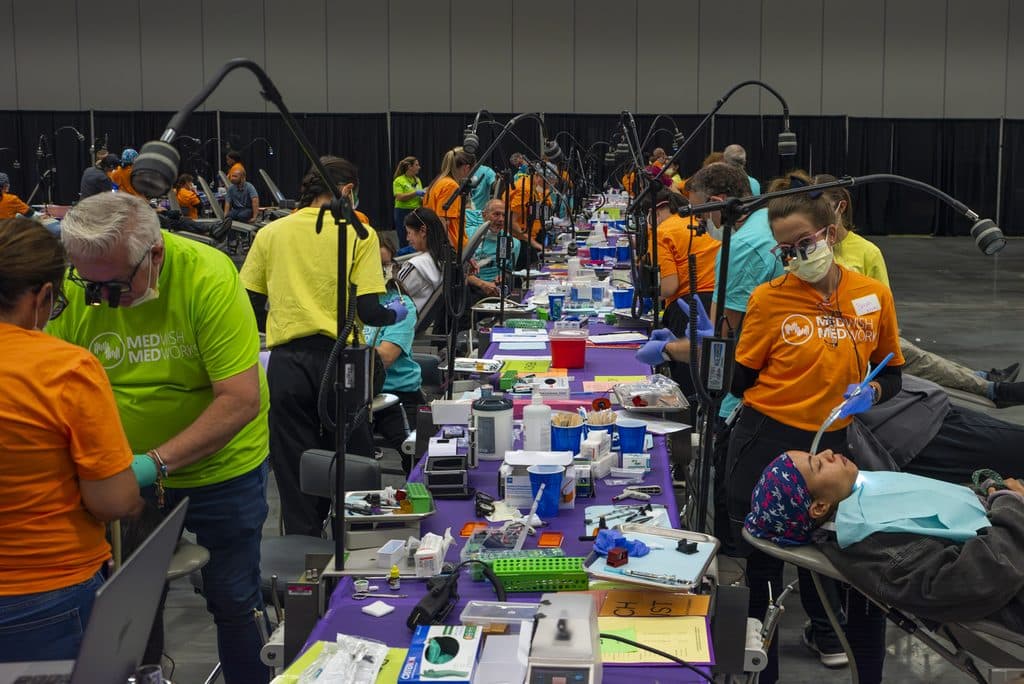
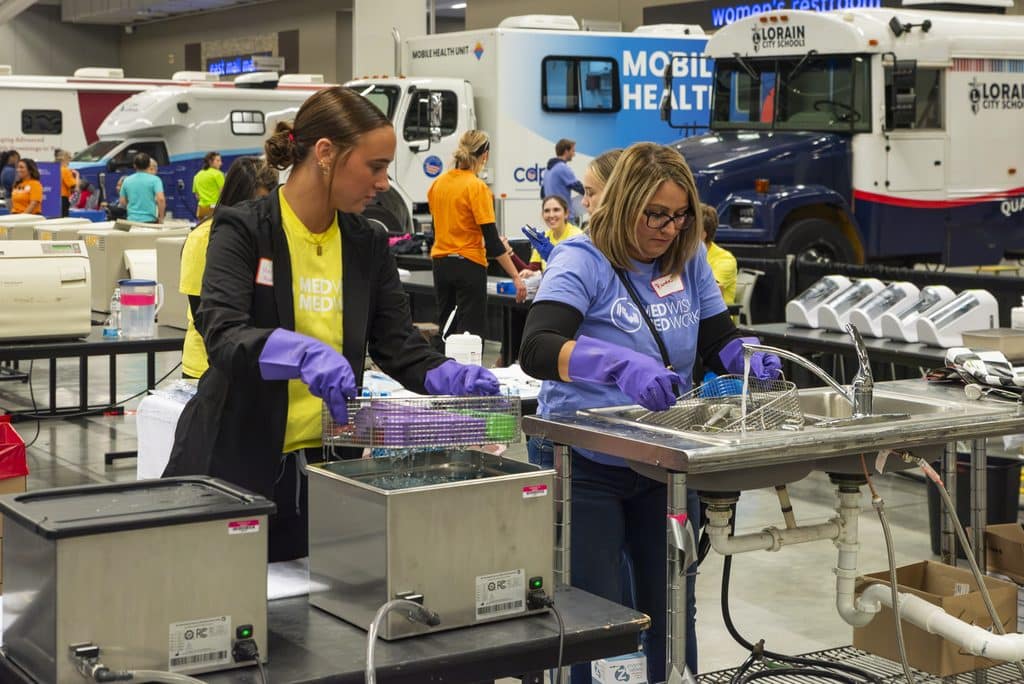
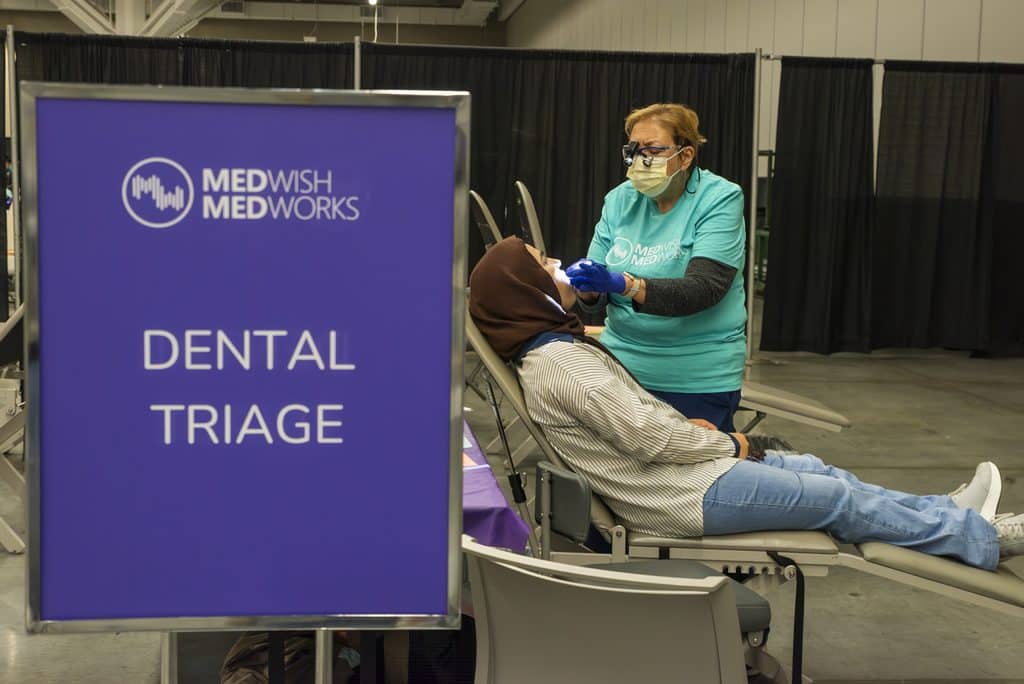
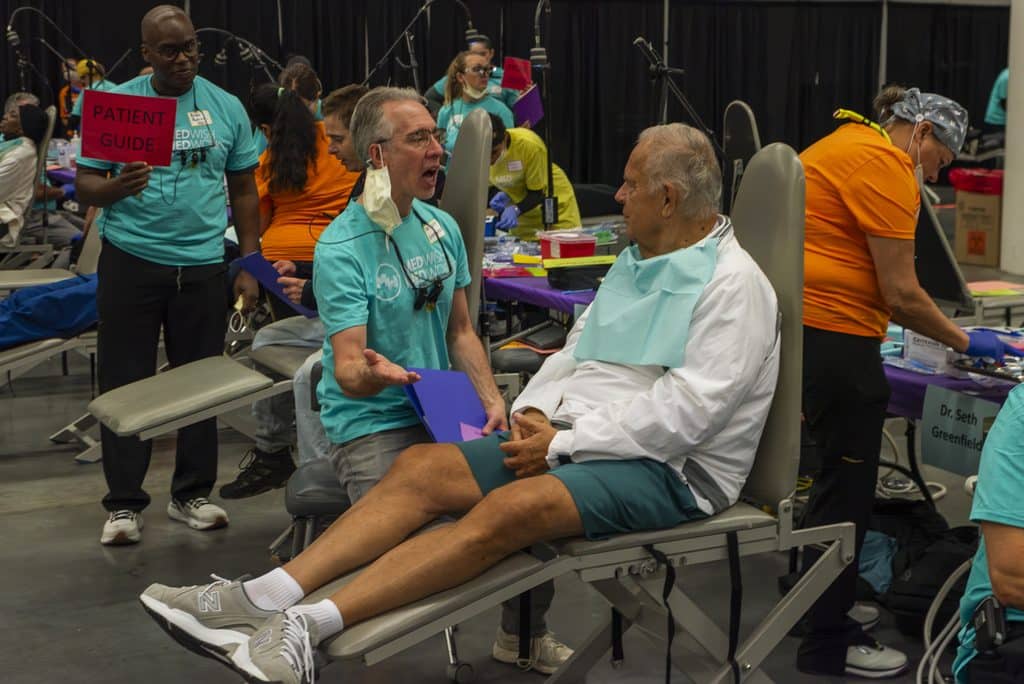
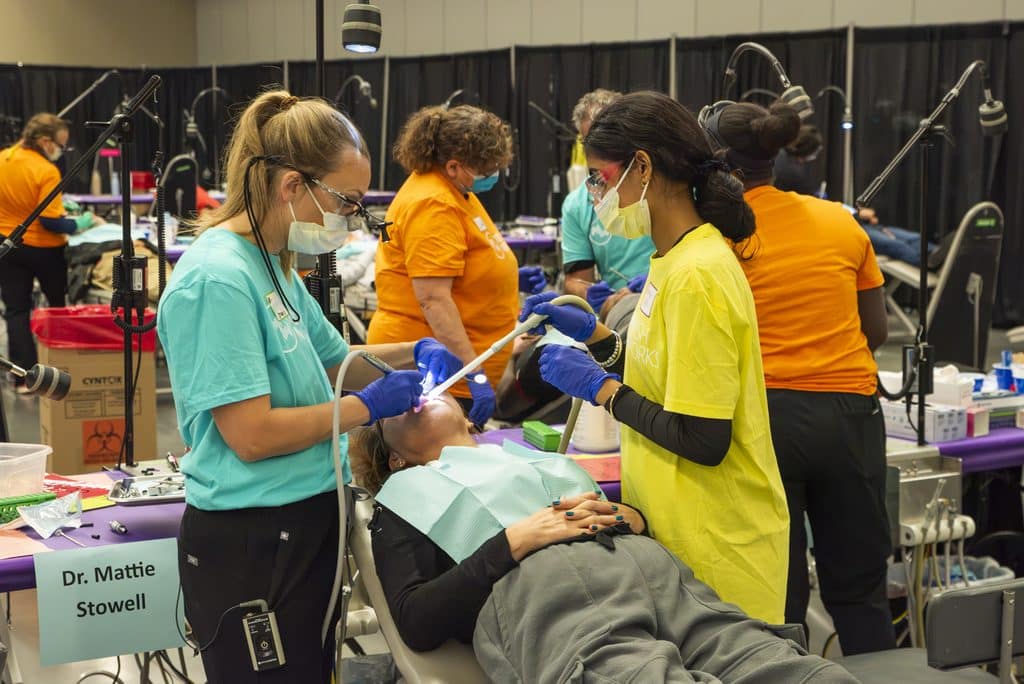
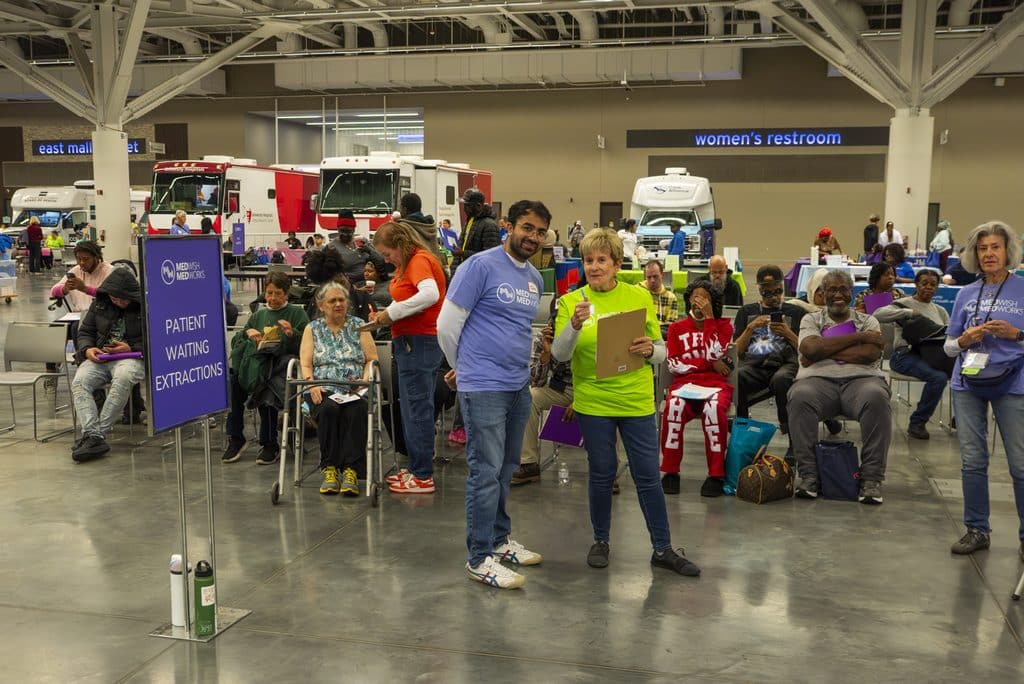
Patients receive treatment at a free MedWish MedWorks clinic Oct. 9-10 in Cleveland. Sponsored by the Delta Dental Foundation, the clinic offered dental, medical and women’s health services. (Photo © Bob Perkoski, www.Perkoski.com)
This story is part of a series on the challenges and solutions related to oral health in Michigan, Indiana, and Ohio. It is made possible with funding support from the Delta Dental Foundation.
A woman who often covered her mouth when she spoke or smiled left a free dental clinic in Cleveland on Oct. 10 with replacement teeth and tears of joy.
Four of her front teeth were badly damaged, recalls Dr. Roger Hess, who leads the clinic’s dental team. Volunteers had already passed their deadline for making removable replacement teeth when a fellow dentist asked him to help one more patient.
Hess removed the teeth, and volunteers scanned her mouth to make a temporary replacement known as a flipper. When she returned that afternoon, a dentist adjusted it before handing her a mirror.
“She just busts out in tears,” Hess says.
The woman received care at a free clinic Oct. 9 and 10 conducted by MedWish MedWorks, a Cleveland nonprofit that works to remove barriers to medical care locally and globally. Sponsored by Delta Dental Foundation, the two-day event at the Huntington Convention Center in Cleveland offered dental care, medical care, and women’s health services to people who might not get care otherwise.
“We do multiple clinics throughout the year, but this is our flagship,” says Britta Latz, chief executive officer of MedWish MedWorks.
Growing to meet the need
The clinic, which started in 2017, has grown from 40 dental chairs to 125, Latz says. Volunteers provided cleanings, fillings, extractions, partial dentures and full dentures. This year, they added crowns made on site.
“We’re able to see and treat just a lot of things that our community really needs,” Latz says.
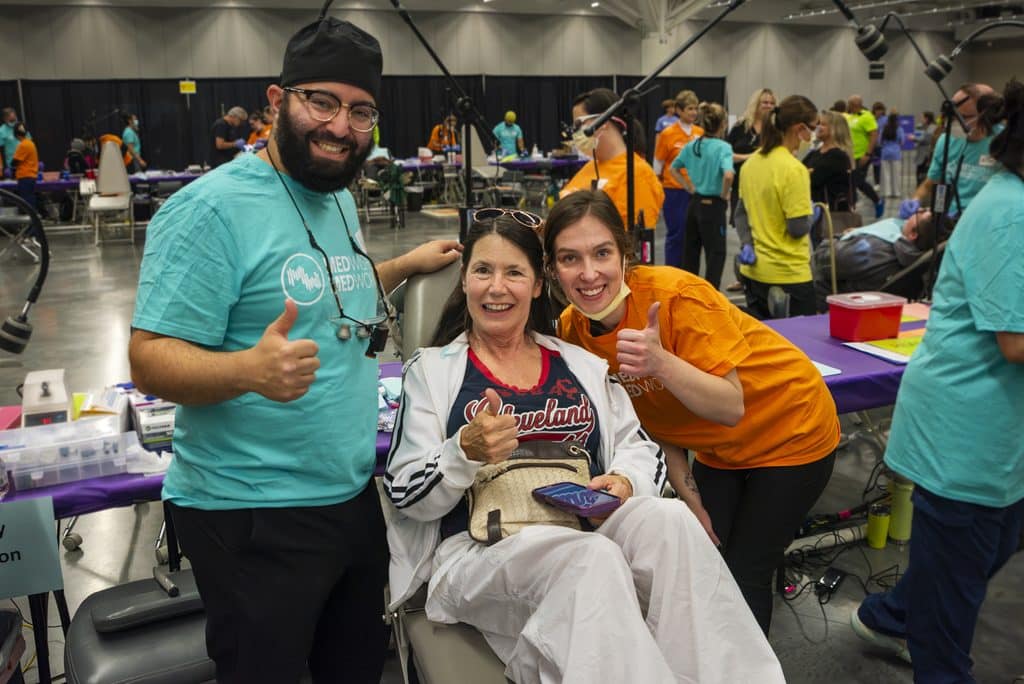
The response also shows how much need remains, says Dr. Josh Miller, an internal medicine physician and the organization’s board chair.
“It’s great that we were able to see so many people, but it makes us realize that there’s still a lot of work to be done to be able to help take care of people in a bigger and broader way,” Miller says.
Miller says the clinic fills a gap for people whose health coverage does not include dental care.
“Dental can be expensive for people, and a lot of folks that do have some insurance, they may not have dental insurance,” he says.
Hess has worked to expand the treatments available at the clinic so dentists can do more to save damaged teeth. “Every year, being able to add a service really is great,” he says.
Changing lives
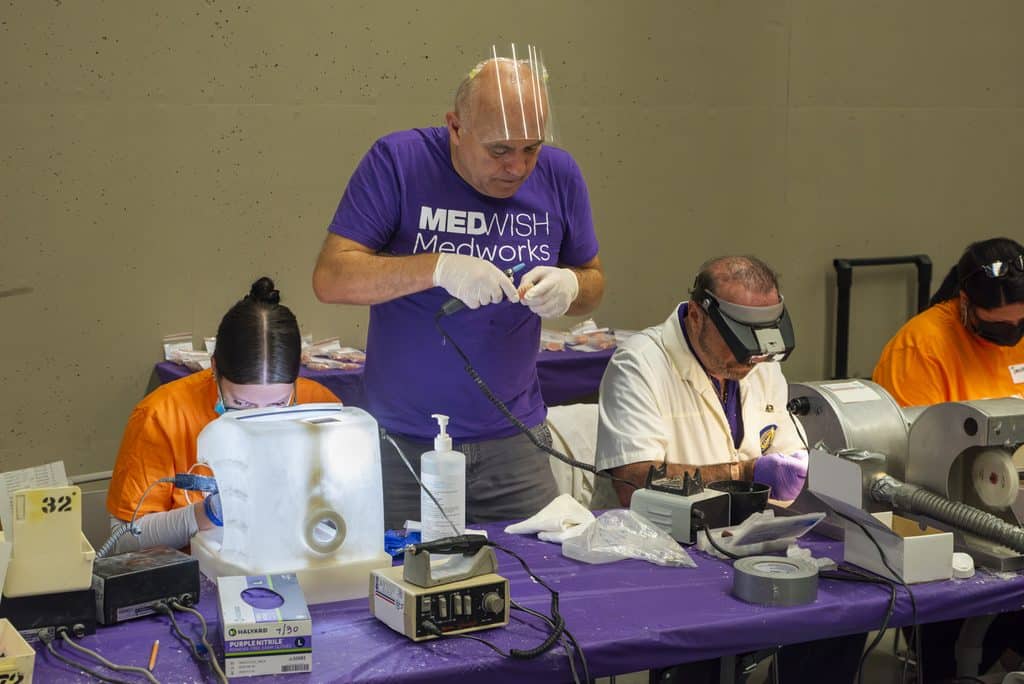
This year, three dentists each day prepared teeth for crowns. Other team members scanned the teeth and used a printer to make the crowns.
Adding such services helps dentists save teeth. A teen could get a crown to fix a tooth instead of having it pulled.
Several years ago, the clinic began making dentures, or replacement teeth, during the event, helping people eat more easily and feel better about their smiles.
Hess recalls a patient who had lost his teeth and become socially isolated. After receiving dentures, the man said he felt ready to ask someone on a date.
Miller says feeling good about their smile also can help people feel more confident at a job interview.
“We’ve been able to do dentures and to give people their smiles back,” he says.
The clinic does not require proof of insurance or identification, Hess says. Patients do not have to explain why they need help.
“I think people realize that when we say it’s really free, it really is free,” Hess says.
More than 1,000 patients were seen over the two days. Doors opened at 7 a.m., and patients began lining up more than three hours earlier.
Some families travel from outside the area. Hess recalls a family from Indiana who took a bus to a previous clinic and spent the night at Cleveland’s downtown bus station before getting care.
This year, a patient of his arranged transportation for another family, bringing the parents and their children in a minivan.
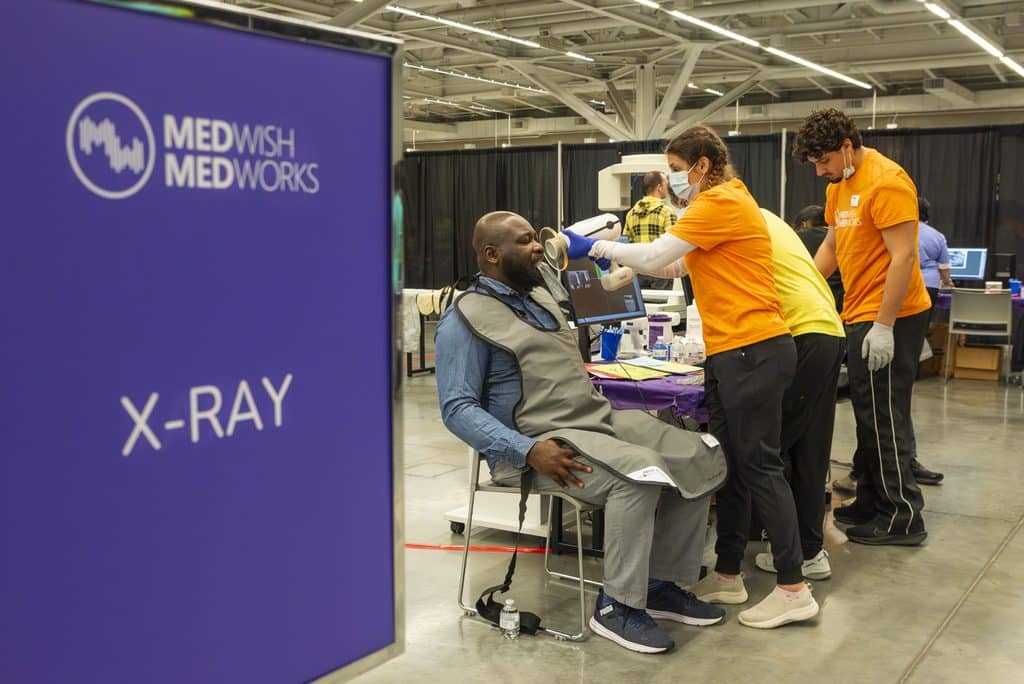
The event offered more than dental care. The October clinic included flu shots, women’s health services, vision screenings, and foot care, allowing people to get several kinds of care in one visit.
Hess says the team has two goals: to help patients with urgent needs, and to support patients who need help beyond what the two-day clinic can offer.
For example, someone with very high blood pressure may need to see a doctor for that before getting dental work. Volunteers make referrals to get that person the right care.
Helping people address their health needs can make it easier for them to work and manage other parts of their lives, he says.
“Healthcare disparity is a huge issue in the United States, not just Cleveland,” Miller says.
Year-round effort
Miller got to know MedWish MedWorks when it helped his family get a hospital bed for his daughter, Maddie, who lives in a group home. Later, he went to Honduras with his wife and their other two children to help people gain access to free medical care.
He joined the board and later became its leader. He served as the medical team lead at the 2025 clinic while working as a doctor at University Hospitals in Cleveland.
When Hess first became involved with the MedWish MedWorks clinic in 2014, he was the only dentist and could not see everyone who needed treatment. He convinced other dental professionals to help out at later clinics.
The effort eventually moved into the convention center, with support from donors, local officials and equipment partners.
Hess estimates that he spends about 300 hours a year preparing for the clinic. Planning begins nearly a year ahead.
“This is really a full-time job, and I have another full-time job,” he says.
He recruits volunteers through relationships built in his periodontal practice and professional organizations. Some dental offices close so their employees can volunteer together.
Dental students also participate, doing clinical work that requires faculty supervision. Hess hopes seeing the difference such care makes will encourage them to keep volunteering after they enter practice.
At morning gatherings, he asks who is volunteering for the first time. Typically, he says, about a third raise their hands.
“I feel like once you experience the joy of everything there, you always come back,” Hess says.
Hess says some regular volunteers could not help this year. They had school reunions or a national dental meeting to attend. Finding enough dental hygienists to clean teeth has also been hard.
Determining direction
The group also brings dental care to young people at the Cuyahoga County Juvenile Detention Center. Hess says the team has held five clinics there. He started with one other dentist and a few portable dental units before asking more volunteers to join.
“The kids were great, and the staff was great,” Hess says.
The team is deciding how to allocate its time and money between large and small clinics. Volunteers can bring dental tools and chairs to schools, libraries, and other places. But even a small clinic takes a lot of planning.
“What we’re finding is the work involved to do a small clinic is not that much less than putting all of our resources together to do the big clinic,” Hess says.
The team has discussed whether two large clinics a year would serve more people than holding many smaller events. Hess says he is still weighing the options.
“With limited resources, both financially and manpower-wise, how can we use it best?” he asks.
Dental professionals, students and other volunteers worked together to provide free care to more than 1,000 patients at the MedWish MedWorks clinic Oct. 9-10 in Cleveland. (Photo © Bob Perkoski, www.Perkoski.com)
Hess is also working with Northeast Ohio Medical University’s new dental school to bring students into the free clinics. He joined the NEOMED faculty so he can guide their work as they begin treating patients. He hopes the experience will encourage them to keep helping people who need care.
“As they reach into the clinic next year, our plan is for me to bring them into these volunteer clinics,” Hess says.
Miller says the reason people come together is clear when he walks into the room.
“It’s just a bunch of people in a room trying to help each other,” he says.
Photos by Bob Perkoski.
Related Articles
Michigan’s community mental health system: Overcoming stigma to provide needed care
Community mental health has played an important role in shifting the culture to asking for help.
High-risk pregnancy doctors publish new standards for care under state abortion bans
A group of maternal-fetal medicine specialists has developed new guidelines to help providers in those states navigate legal risks for themselves and medical challenges for their high-risk patients, Stateline reports.
New arrivals in the ER? Georgia gears up to solve rural maternal health crisis
Most of Georgia’s counties are without a labor and delivery unit. To fill those gaps, the state is looking to equip emergency rooms to handle obstetric emergencies. Advocates and doctors worry, however, that the ER is being used as a stopgap.