CMHA: Telling the whole story about Michigan’s public mental health system
The Community Mental Health Association of Michigan gives a voice to the issues and the people experiencing them.
The Community Mental Health Association of Michigan (CMHA) represents Michigan’s 46 community mental health boards (CMHs) and more than 80 nonprofit agencies providing or supporting behavioral health care across the state. This trade association serves its members three ways: educational conferences, training, and events; extensive online resources; and effective policy advocacy at the state and federal levels.
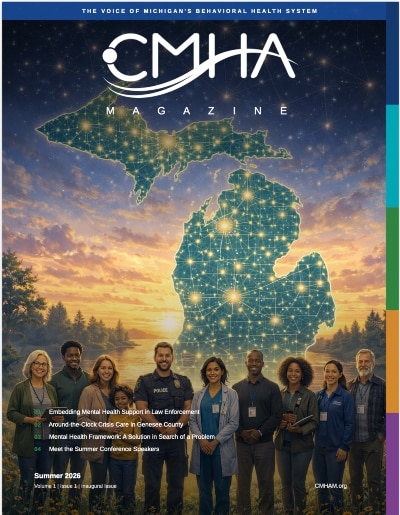
This summer, CMHA debuted the first edition of CMHA Magazine, highlighting policy updates and stories from Michigan’s public and community mental health organizations. Alan Bolter, CMHA’s new CEO, noted in his introduction to the first issue, “Michigan consistently ranks among the top states for access to mental health services, and our community-based model of care has become a national example.”
MI Mental Health spoke with Bolter about CMHA’s advocacy for a strong community mental health system that reflects local needs and the importance of making mental health care more accessible for all Michiganders.
Q. Why is it important that residents and policymakers have an accurate picture of how community mental health serves Michiganders?
A. Michigan’s community mental health system serves 350,000 people across the state in every county in the state of Michigan. These are individuals living with serious mental illness, substance use disorder, intellectual developmental disabilities, and kids with serious emotional disturbances. In many cases, these are individuals with the most complex needs.
Public perception and public policy should be grounded in facts, not isolated anecdotes. While no system is perfect, the overwhelming majority of people receiving services are supported safely and successfully in their own communities rather than in institutions.

Our community mental health entities are accountable to their local boards at the county level. They’re accountable to the state and the federal government. They go through rigorous oversight and performance standards. They provide crisis services 24 hours a day. They coordinate across multiple systems, multiple community partners, and they are the safety net in their community when no one else is available.
Policy makers need to get a complete picture of their challenges and successes. So, when they make decisions, they can make decisions based on their strengths. A lot of times, we’ll see unintended consequences that come up with some of the decisions that they make. CMHA tries to give as much information to decision makers as possible, so they can build on the current system, not unintentionally unravel it.
Q. How does CMHA help provide them that information?
A. We are the statewide association that represents Michigan’s public mental health system. We represent 46 community mental health entities, 10 prepaid inpatient health plans (PIHPs), and about 70-plus provider organizations.
We serve as a trusted resource for policymakers, the media, and the public. We collect data, share data, highlight outcomes, explain how the system operates, and elevate the voices of our members to legislators. If they don’t have a loved one that receives mental health services, they don’t have a real grasp on what our members do.
We are trying to be a voice for our members and more a voice for the people — to put a face to the issue. We almost play air traffic controller. We’re trying to connect all the dots that are out there.
Q. What do our policymakers need to know before making decisions that affect how Michigan does public mental health care?
A. It’s really trying to get them to focus on the real barriers to care — access to care, crisis inpatient needs, and workforce. They are not inexpensive fixes. How do we build on the current system?
One key issue is the lack of inpatient beds. There’s just not enough beds, not enough settings here in Michigan. When we talk to legislators, we focus on, ‘How do you solve that issue?”
We’re trying to best inform and educate policymakers on the issues, getting to the crux of the problem, and helping to find a solution to the actual problem, not some anecdote that’s out there.

Q. How does the new CMHA Magazine complement your policy advocacy for community mental health?
A. A lot of times, when policymakers are contacted regarding the public mental health system, it’s as a result of a tragedy. It’s usually not seen in a good light. All too often, they don’t hear the good things that our members do. We’re really trying to highlight all the great work that takes place across the state.
Another one would be to highlight the hot button issues that our members are facing. I reached out to Representative Matthew Bierline, a state representative from the Lapeer County Bay County area. He was working on a package of bills regarding inpatient care and inpatient access. I asked him to write an article for the magazine. So, it’s also a way to highlight the work that policymakers are doing. Outside of that, the magazine highlights the work that we’re doing through the association on our members’ behalf.
Readers who would like to connect with the community mental health agency in their county can find contact information on the CMHA website here.
Photos by John Russell, John Grap, and Doug Coombe.
Photo of Sanilac County CMH and Matt Hill courtesy subjects.
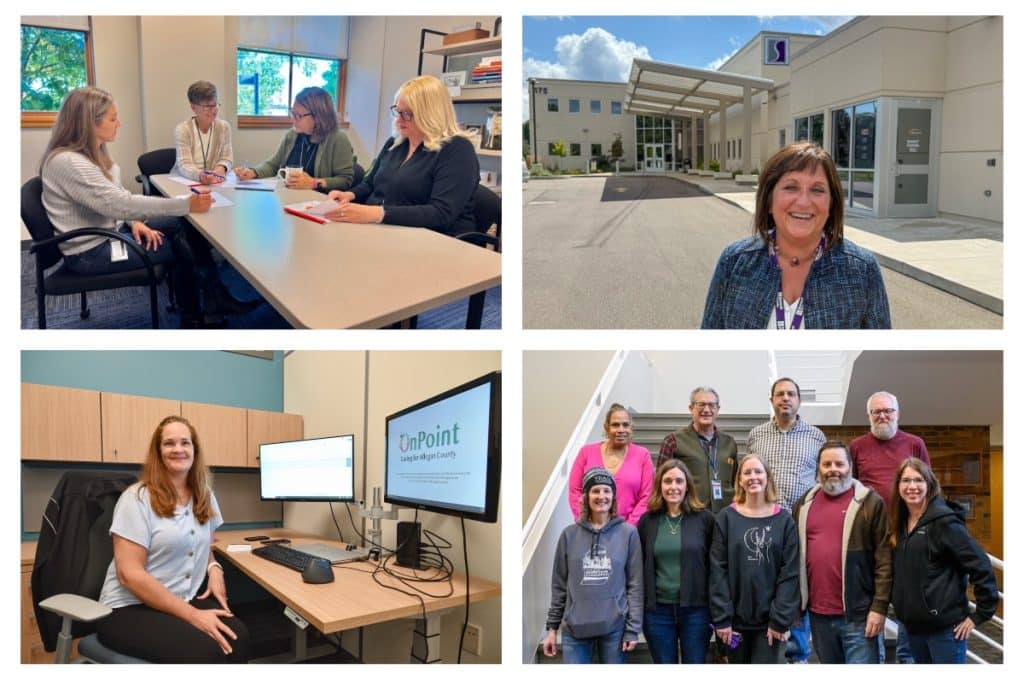
The MI Mental Health series highlights the opportunities that Michigan’s children, teens and adults of all ages have to find the mental health help they need, when and where they need it. It is made possible with funding from the Community Mental Health Association of Michigan, Center for Health and Research Transformation, Lifeways, OnPoint, Sanilac County CMH, Summit Pointe, Michigan Health and Hospital Association, Washtenaw CMH, and Public Safety Preservation Millage.
Author

Related Articles

Dementia care navigators help Coloradans get the support they need
Launched in 2024 by the Centers for Medicare and Medicaid Services, the GUIDE model provides care and support for Medicare beneficiaries living with dementia as well as their caregivers.
University of Michigan program offers expensive denture treatment for free
The University of Michigan’s Senior Implant Overdenture Restorative (SenIOR) program offers implant overdentures for free and is aiming to improve insurance coverage for the treatment.
GuardCare partnership brings free healthcare to Ohio Appalachian residents
GuardCare provided free health services to nearly 500 Ohio residents, highlighting both collaborative solutions and persistent gaps in dental care.