Adaptive re-use of LaunchCode’s facility opens doors for future technology development workforce
Impactful developments don’t always come from brand-new, ground-up builds. Sometimes significant renovations to an existing building can open the doors for expanded capacity, programming and a further revitalization of the surrounding community. With support from IFF, LaunchCode was able to complete an adaptive re-use of a former state unemployment office for their technology workforce development nonprofit.
This story is part of a four-part series about the community development financial institution IFF’s innovative and impactful resources positively shaping the Midwest communities in which they serve. This series is supported by IFF.
Impactful developments don’t always come from brand-new, ground-up builds. Sometimes significant renovations to an existing building can open the doors for expanded capacity, programming and a further revitalization of the surrounding community. With support from IFF, LaunchCode was able to complete an adaptive re-use of a former state unemployment office for their technology workforce development nonprofit.
IFF, the Midwest’s largest community development financial institution (CDFI) works to uplift neighborhoods by providing community-centered lending, development and real estate consulting to urban and rural communities — providing affordable financing to nonprofits in the housing, education, health care, and arts and culture sectors among others. With their headquarters in Chicago, IFF also has Midwest regional offices in Cleveland, Columbus, Detroit, Grand Rapids, Indianapolis, Kansas City, Milwaukee, and St. Louis.
LaunchCode, a tech workforce nonprofit in St. Louis, Missouri’s Fountain Park neighborhood, launched in 2013. Founder Jim McKelvey noticed that there was a gap in the tech workforce, so he created free education and job placement for folks. Their mission is to increase access to tech careers to those who have historically been under-resourced like BIPOC learners and women.
The company provides people with little or no experience in computer science free intensive training and job placement assistance in software development, data science, IT product management and more.
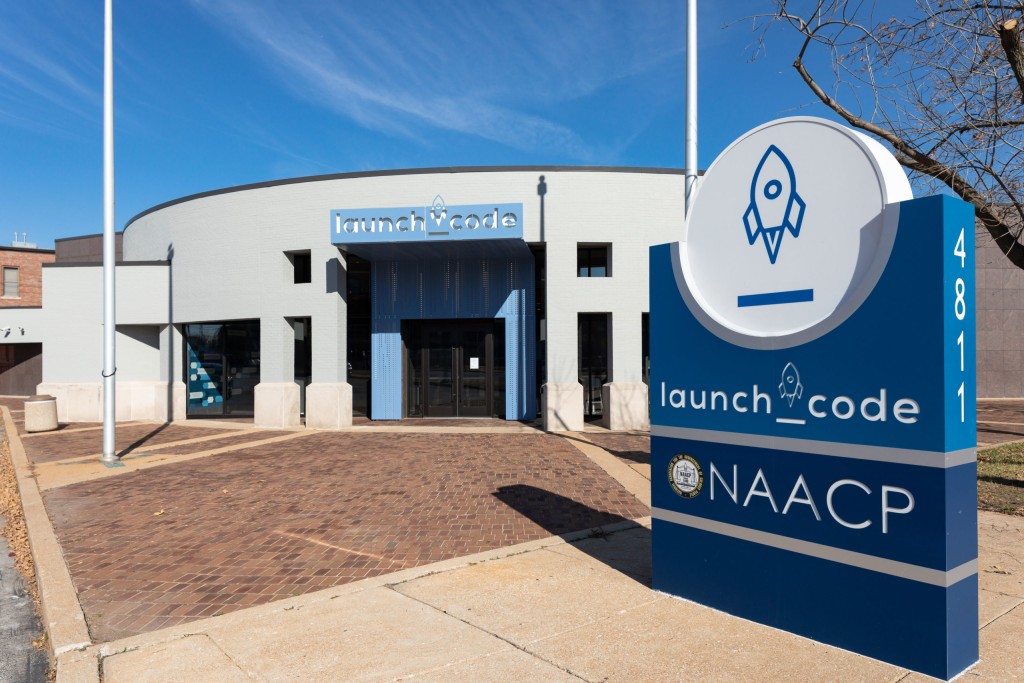
When the nonprofit learned their landlord was going to sell the property, LaunchCode purchased the facility — with a loan and support from IFF in 2019. The former State of Missouri unemployment office underwent a $5 million transformation of the 18,700-square foot space. Funding and financing came from IFF, Missouri Department of Economic Development Neighborhood Assistance Program, City of St. Louis Community Development Block Grant, New Market Tax credits and private donors.
Amber Korf is director of lending for the Southern Region at IFF, leading capital solutions work in Missouri, Kansas, Iowa, and Southern Illinois. She works on business development alongside organizations looking for financing a capital project, underwriting, and maintaining those relationships.

“IFF exists to support non-profits and that includes being responsible stewards of their dollars when it comes to consulting on and financing facility projects,” Korf says. “A redevelopment can be less expensive and take less time – in turn, nonprofits can use their revenue for programming and operations and keep doing their work with less interruption. Our Real Estate Solutions team is an incredible resource for non-profits considering a capital project. They can support with feasibility studies, project management, and construction oversight. An adaptive reuse project can require more experience to execute well; that in-house expertise can make a complex reuse project go more smoothly and efficiently.”
Korf has witnessed IFF’s involvement in nonprofits who have redeveloped underused and vacant properties including schools turned into apartments.
Many of our clients’ work is concentrated in disinvested communities,” Korf says. “It’s important to many of them to restore a community asset, as it illustrates their mission and commitment to their communities.”
Ethan Leigh is the CFO at the LaunchCode Foundation, and has been with the organization since 2016. Over the past 10 years, he’s seen LaunchCode grow significantly.
“It’s been a really exciting journey to see the impact that we have on so many folks’ lives,” Leigh says. “That’s the thing that certainly keeps me here — is watching folks go through our programs and get placed into high-wage, sustainable careers in technology.”
Leigh recalls when LaunchCode began using the space at 4811 Delmar Blvd. as their facility to run 150-person face-to-face classes. The State of Missouri space was unused for years, and provided a good place to host the courses.
“The Delmar Divide in St. Louis is one of the biggest wealth and racial gaps in the country,” he says. “The property sits right on the line on the North side — it’s central in the city of St. Louis, kind of in the heart. It’s accessible to folks in Illinois, on the other side of the Mississippi River, and then St. Louis County. The location was perfect for folks to be able to access the facility.”
Jeff Mazur is a partner at Greater St. Louis Inc., overseeing the public policy and strategy teams for growing the region. Before this role, Mazur worked at LaunchCode as the executive director from 2017 to 2022, working closely in 2017-2018 with IFF folks on the acquisition of the building.
Being headquartered in the Delmar Divide, a place where a lot of economic inequality was demonstrated — is crucial, says Mazur. During his time at LaunchCode, he witnessed the impact the free high-quality software development program had on thousands of people who utilized it. Parents in low-income jobs, the unemployed, or those with part-time retail jobs could learn skills at night and get placed in jobs and apprenticeships — changing their lives forever.
As the company continued to grow, it began outgrowing its space and capabilities.
“The old unemployment office had this big open area for people to get services and meet with folks, and offices surrounding the perimeter,” Leigh says. “We just needed the space to be ours and updated for our purpose. Jeff Mazur, our (former) executive director at the time, connected with Stephen Westbrooks at IFF. They were able to help us secure a loan to get this building, and we’re incredibly grateful for that.”
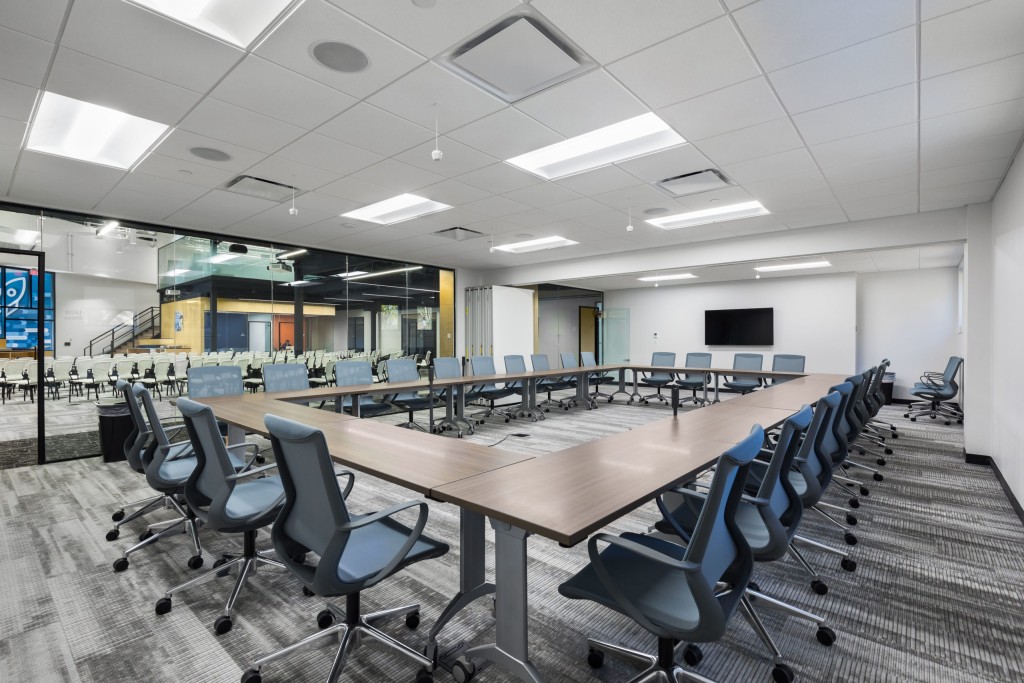
Developers, government programs, private and public donors all led to the huge transformation kicking off in 2020. The new mezzanine second floor added 4,000 square feet of staff space overlooking the learning environment below. Former staff spaces became breakout rooms for learning groups.
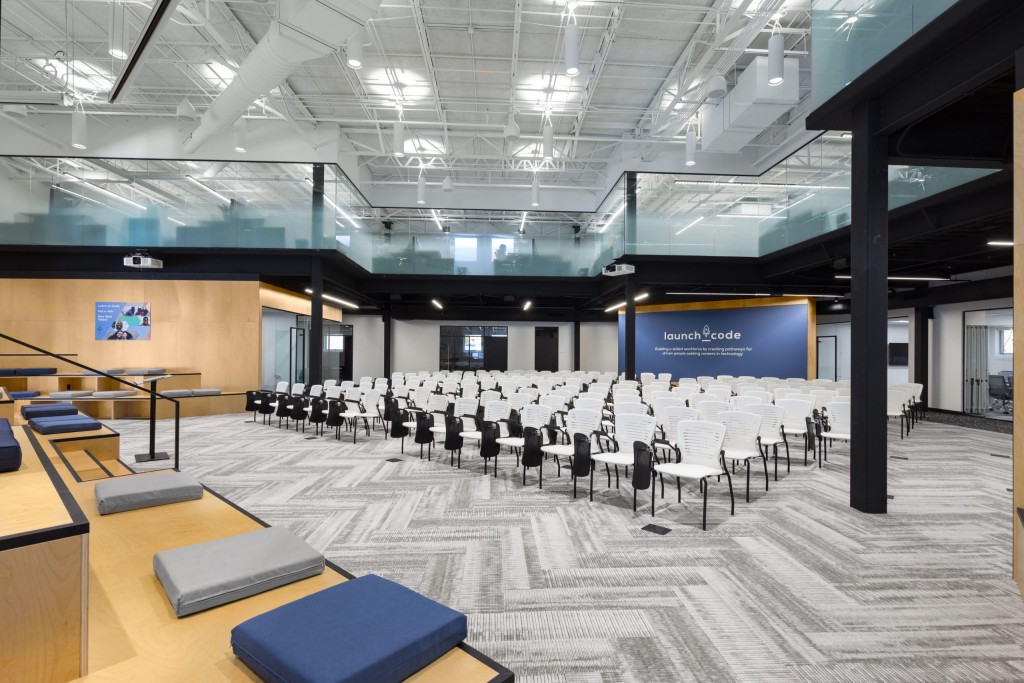
“It really met all the needs that we needed, and we’re very grateful for IFF to come in and kind of save the day there,” Leigh says. “We named each of our rooms after something that was important to LaunchCode. There’s a room named after Stephen Westbrooks (executive director for the Southern Region at IFF). He was definitely integral to the acquisition and long-term plan of this facility.”
Up until 2024, in-person classes took place at the facility before transitioning to mainly remote virtual learning classes in 2025 and beyond. Today, the space is still utilized for meetings and meetups with students and clients, staff space, annual events, and community partner events.
“The long-term plan is to continue to use this facility for education purposes,” Leigh says. “We’re ramping up this Hire Human program right now. We’ve had a lot of interest, we’ve had close to 4,000 people enrolled and engaged in these courses — AI 101 in particular. That need is certainly going to be relevant and a space for people to come share ideas, do mock interviews, and all those things.”
Hire Human is an initiative that focuses on ensuring people aren’t replaced by technology, rather, they’re equipped to work alongside AI.
Leigh says the market has shifted, and the demand for software development talent has shrunk when it comes to entry-level talent.
“As we look at what the future of technology is bringing, AI — I know that’s a pretty blanket term, but the skills in an AI-enabled workforce is going to be something that there is demand for. We’re seeing that from our employer partners pretty strongly right now.”
LaunchCode met with community clients, asking about the types of roles that are going to exist in their organizations — even if there aren’t job titles yet.
“Because things are changing so fast, people need to have that foundational understanding of how these tools interact and work, what they’re there for, and the guiding principles behind how to use them,” Leigh says of the free LaunchCode AI 101 online course.
After completing that course, students can pursue the AI specialist role or the AI engineer track.
Over the past 13 years, LaunchCode has continued to build pathways to economic opportunity — launching more than 4,000 careers with an average earning of $100,000 after five years, working with more than 500 hiring partners nationwide, and creating $300 million in annual economic impact.
These new career opportunities not only provide higher earnings, but also greatly impact the employees and their families. That positive impact also has a trickle-down effect on their surrounding communities. IFF reports a 33% increase in the number of program participants served annually (600 to 800) at LaunchCode, which served as a catalyst for $84 million in additional development in a three-block area surrounding the facility.
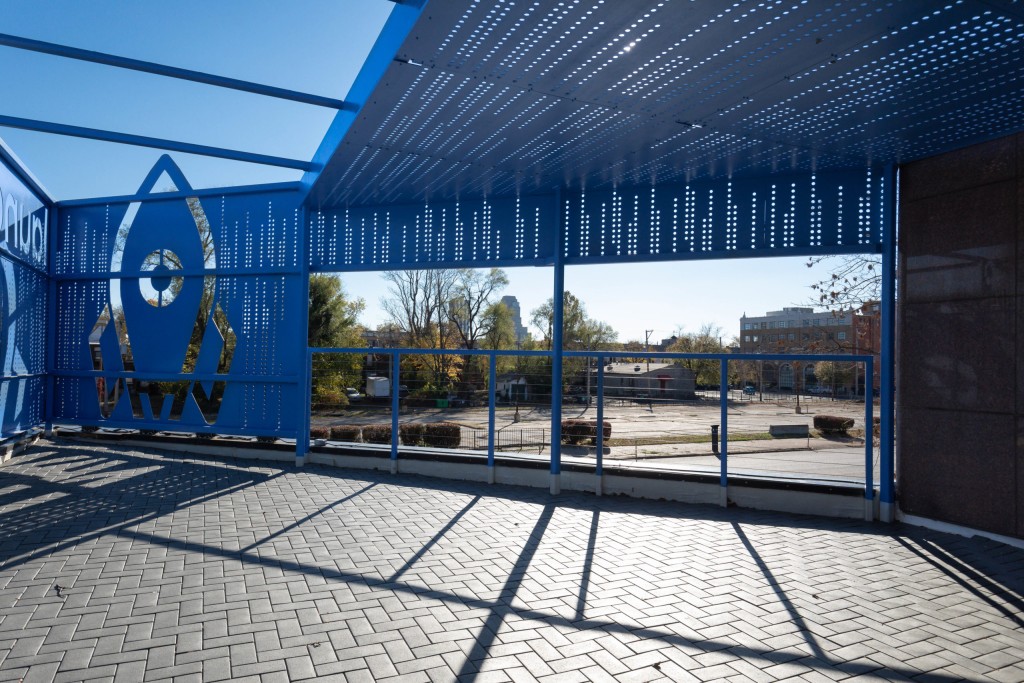
Unfortunately, a devastating tornado touched down in the neighborhood back in May 2025. Leigh says recovery efforts are still underway on commercial and residential properties.
Mazur says the tornado did roughly $1.8 billion worth of damage to a number of neighborhoods in North St. Louis, including Fountain Park where LaunchCode is.
“Many homes and buildings were devastated literally blocks from LaunchCode’s facility,” Mazur says. “Much of that still remains to be fully rebuilt and recovered.”
Although it’s been nearly four years since Mazur left his position at LaunchCode, their mission remains close to his heart.
“I still know how important the organization’s mission is to St. Louis,” he says. “I think about that facility and where it sits — it already occupied this symbolic place of importance on the Delmar Divide. Now it also occupies this place, kind of a scar from the tornado which displaced many people and put many people in even more challenging personal and financial situations. When you have an organization like LaunchCode there, it presents this space of possibility.”
Even though technology is always changing, Mazur says the organization’s mission remains steadfast.
“This is a place that’s about opening the door to people who oftentimes haven’t had many doors open to them,” he says. “
IFF opening up its doors for LaunchCode to celebrate their doors reopening at their transformed facility is a story Mazur and others won’t soon forget.
“If a CDFI like IFF didn’t exist, there would have been no opportunity in the typical lending market to be able to borrow money to buy that building,” he says. “The organization would have been pushed out of a place that had been its home for years. It would have had to find a different place in a different neighborhood that may not have worked as well. As we think about organizations, whether they’re workforce organizations like LaunchCode, or other community development corporations, or those trying to build under-served communities — we know that access to capital is highly restrained. The presence and willingness of organizations and institutions like IFF become even more critical to fill that gap.”
Related Articles
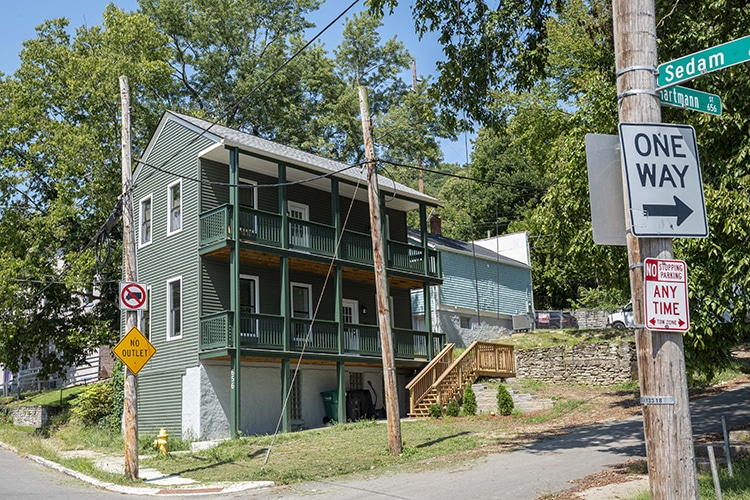
Restoring a Cincinnati neighborhood one historic home at a time
An $8.4 million investment is bringing homeownership and a renewed sense of possibility to one of Cincinnati’s smallest neighborhoods.
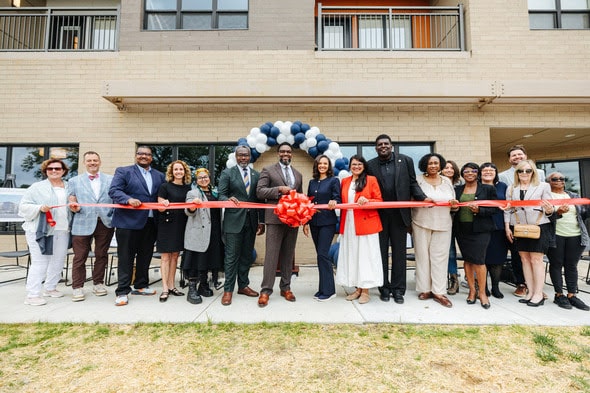
Minock Park Place provides new affordable senior housing for Detroit’s older residents
In the heart of Detroit’s Grandmont Rosedale neighborhood, a 42-unit, mixed-use development has given senior citizens brand-new affordable housing. Minock Park Place was seven years in the making, and marks the first affordable senior housing community in the neighborhood, located at 19505 Grand River Ave. — a vital commercial and cultural artery.
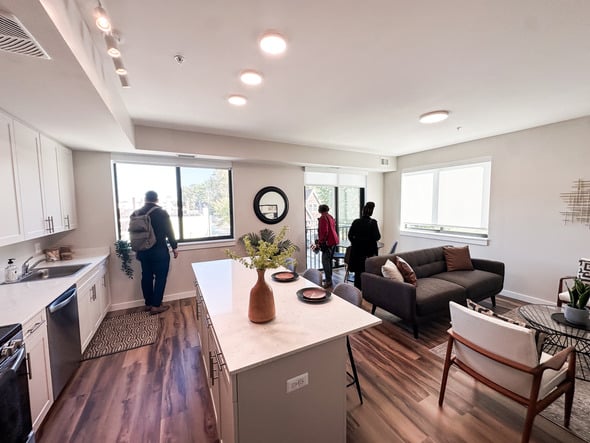
Detroit Housing for the Future Fund returns to drive affordable housing, stable neighborhoods
The second phase of the Detroit Housing for the Future Fund (DHFF) returns, offering communities across the city the opportunity for more affordable, stable neighborhoods.